Research steps
Measure physical markers of attention
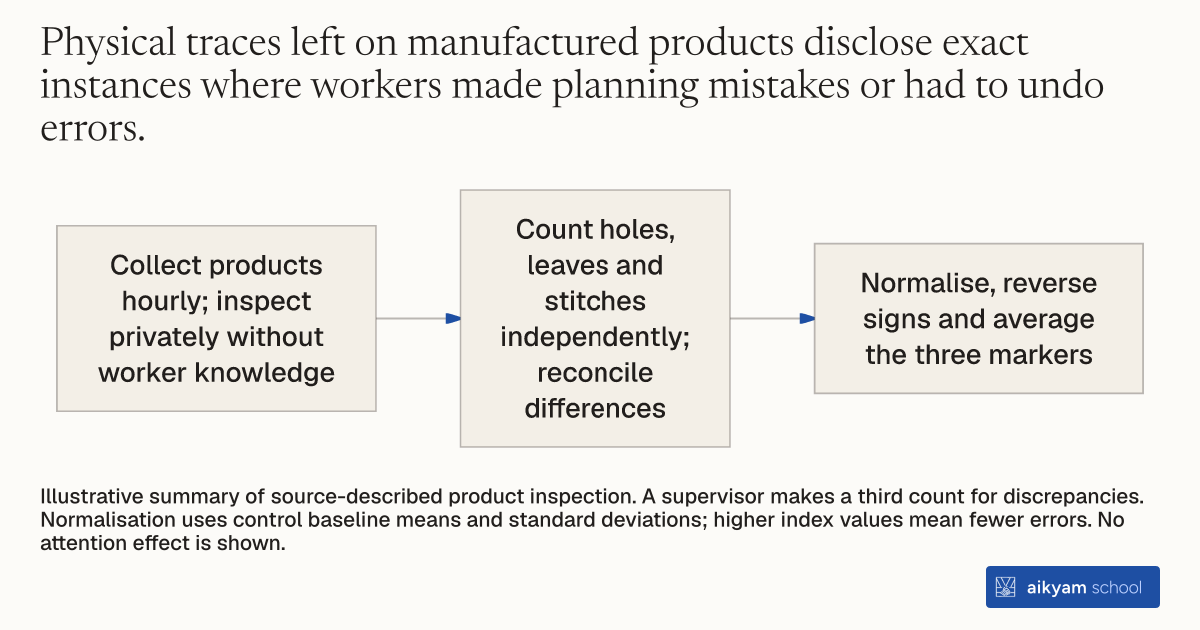
- Collect products hourly; inspect privately without worker knowledge
- Count holes, leaves and stitches independently; reconcile differences
- Normalise, reverse signs and average the three markers
Illustrative summary of source-described product inspection. A supervisor makes a third count for discrepancies. Normalisation uses control baseline means and standard deviations; higher index values mean fewer errors. No attention effect is shown.
See source →How
When to use
Assess real-time worker focus and cognitive engagement during manual manufacturing tasks without creating Hawthorne effects or surveyor demand bias. It solves the difficulty of measuring worker attentiveness directly on the shop floor when psychometric surveys or paper tests fail to capture job focus. It serves factory managers, quality auditors, and researchers evaluating how worker mental state affects production quality.
Quantify worker attentiveness by auditing physical error markers on finished products without worker knowledge.
- Collect finished manufactured items from worker workstations at the end of each work hour under the administrative premise of clearing work areas.
- Transport the collected items to a private inspection room away from the view of workers.
- Have two independent inspectors inspect every item and record three physical markers: double holes indicating removed stitches, total leaves used, and total stitches applied.
- Have a supervisor perform a third count to resolve any discrepancy between the two inspectors.
- Normalize the counts for each of the three physical markers using the control group baseline mean and standard deviation.
- Reverse the sign of the normalized values so higher numbers represent fewer errors and average them into a single attentiveness index.
Why it works
Inspecting products covertly prevents workers from altering their behavior or gaming quality metrics.
Example
At rural Indian manufacturing worksites producing sal leaf plates, research staff collected completed plates hourly and recorded double holes, leaf counts, and stitch counts in a private back room. After treated workers received mid-contract liquidity infusions, their attentiveness index increased by 0.077 standard deviations overall and 0.170 standard deviations among below-median wealth workers.
About the study
Participants
408 male casual manufacturing workers aged 18 to 55 across 14 experimental rounds in Odisha, India (13,020 worker-hour observations).
Study Design
Unannounced hourly collection and double-blind dual-counting of three physical product markers (double holes, leaves, stitches) normalized into a standardized attentiveness index across control and interim cash payment groups.
Results
Cash infusions increased worker attentiveness by 0.077 SDs overall (p=0.092) and 0.170 SDs among poorer workers (p=0.041), whereas piece-rate wage increases produced no attentiveness change (-0.013 SDs, p=0.198).