Research steps
Check drinking after incentives end
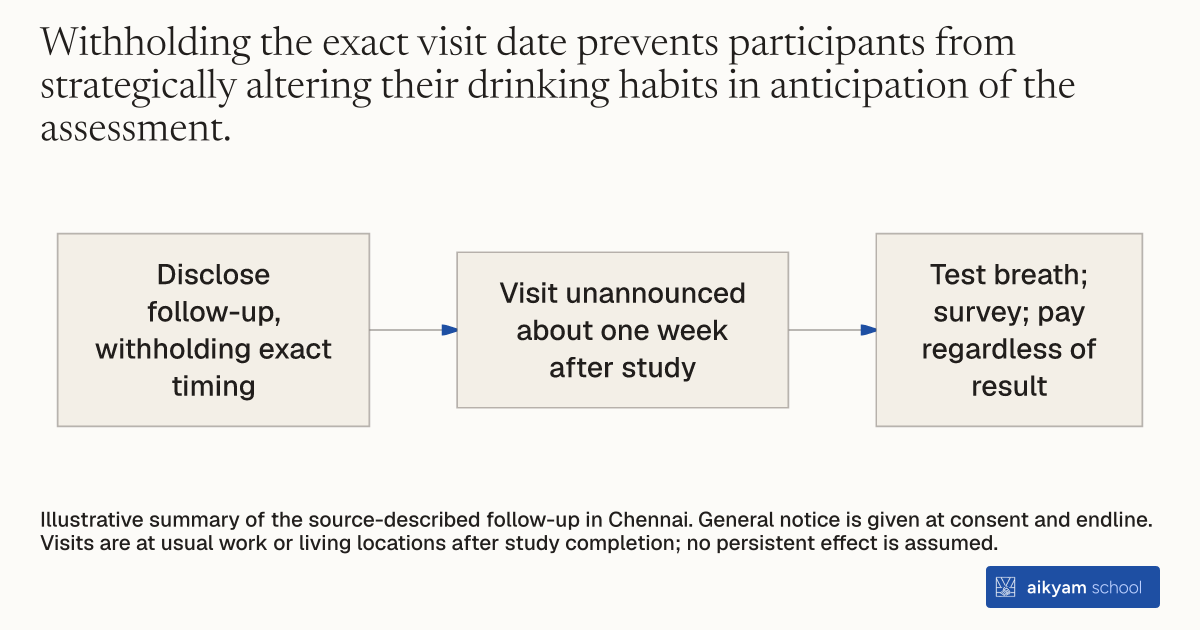
- Disclose follow-up, withholding exact timing
- Visit unannounced about one week after study
- Test breath; survey; pay regardless of result
Illustrative summary of the source-described follow-up in Chennai. General notice is given at consent and endline. Visits are at usual work or living locations after study completion; no persistent effect is assumed.
See source →How
When to use
Behavioral interventions and incentive programs face the challenge of measuring whether behavioral changes persist after incentives end. Announced follow-up visits allow participants to temporarily adjust their behavior or abstain from drinking specifically for the appointment. Use this method to measure post-intervention persistence by conducting unannounced field visits with objective diagnostic testing.
Conduct unannounced post-intervention field visits to test whether treatment effects persist after financial incentives cease.
- Study staff announce during initial consent and endline surveys that a follow-up visit will occur approximately one week after the study ends.
- Staff withhold the exact date and time of the follow-up visit from participants.
- Surveyors locate participants at their usual work or living locations unannounced approximately seven days after study completion.
- Surveyors administer a precision breathalyzer test immediately upon locating the participant.
- Surveyors conduct a follow-up survey on drinking and primary outcome measures, providing fixed compensation regardless of breathalyzer scores.
Why it works
Unconditional compensation ensures that measured blood alcohol content reflects natural post-study behavior rather than temporary compliance driven by testing bonuses.
Example
In Chennai, surveyors conducted unannounced follow-up visits approximately one week after participants completed the 20-day study. Surveyors breathalyzed and surveyed rickshaw drivers at their usual work locations, finding that financial incentives produced no persistent reductions in alcohol consumption once daily incentives ended.
About the study
Participants
229 male cycle-rickshaw drivers aged 25 to 60 in Chennai, India.
Study Design
Unannounced single-visit follow-up evaluation conducted approximately 7 days post-treatment with unconditional compensation and breathalyzer testing.
Results
Post-study breathalyzer tests revealed no significant differences in sobriety or drinking levels between former incentive recipients and control participants once daily incentives ceased.