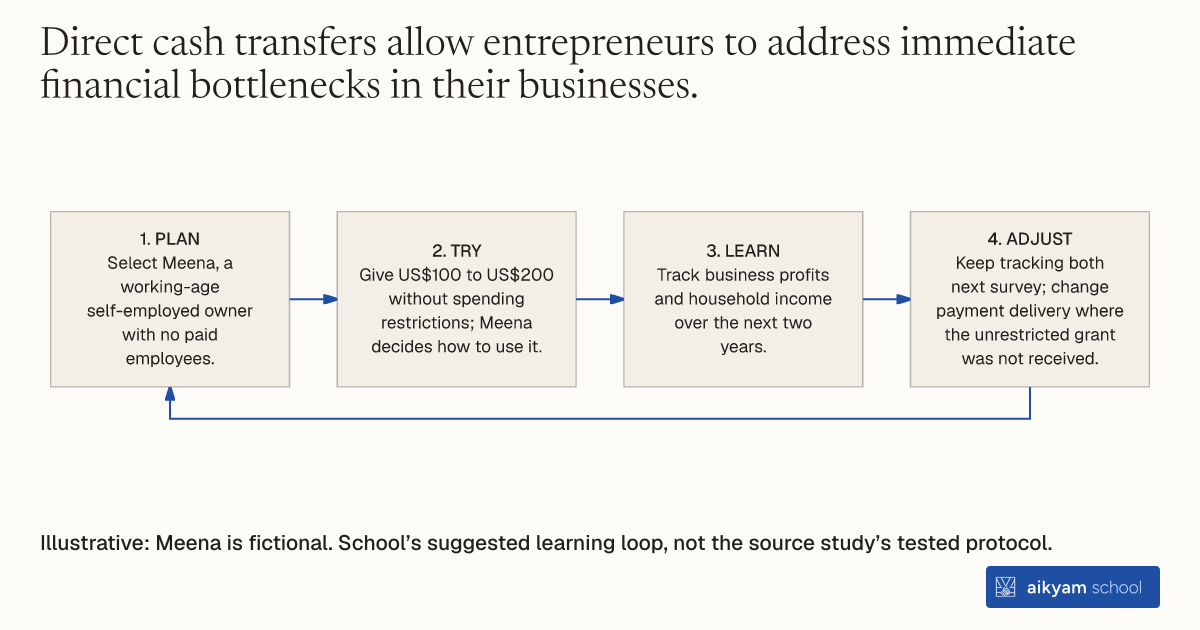
Try, learn and adjust
Check unrestricted business grant delivery
- Plan: Select Meena, a working-age self-employed owner with no paid employees.
- Try: Give US$100 to US$200 without spending restrictions; Meena decides how to use it.
- Learn: Track business profits and household income over the next two years.
- Adjust: Keep tracking both next survey; change payment delivery where the unrestricted grant was not received.
Illustrative: Meena is fictional. School’s suggested learning loop, not the source study’s tested protocol.
See source →School’s suggested, untested loop. Observe grant receipt, business profits and household income; do not assume the grant stays within one business.
How
When to use
Micro-entrepreneurs in developing countries often lack liquidity to grow their businesses. Unconditional cash grants provide capital without debt or spending restrictions. Nonprofits and development programs use cash grants to ease liquidity constraints for self-employed business owners.
Provide unconditional cash grants directly to self-employed micro-entrepreneurs to expand business operations.
- Identify working-age self-employed micro-entrepreneurs who have no paid employees.
- Select target entrepreneurs across low-income communities.
- Disburse unconditional cash grants valued between US$100 and US$200 directly to individual business owners.
- Allow recipients full discretion to invest or spend the cash funds without restrictions.
- Track business profits and household income over the two years following grant disbursement.
Why it works
Sole female entrepreneurs invest cash into their own firms, whereas female owners in multi-enterprise households often redirect cash to family members' businesses.
Example
Researchers provided unconditional cash grants valued between US$100 and US$200 to micro-entrepreneurs in Sri Lanka, where female sole business owners increased profits by 30 percent while grants showed no overall profit impact for women in multi-enterprise households.
About the study
Participants
408 self-employed micro-entrepreneurs with no paid employees in Sri Lanka and 793 entrepreneurs in Ghana.
Study Design
Randomized controlled trial comparing micro-entrepreneurs offered unconditional cash grants, in-kind grants, or no grants over two years.
Results
Grants increased business profits by 30 percent for female micro-entrepreneurs who were the sole business owners in their households, but had no overall impact on profits for female business owners across all households.