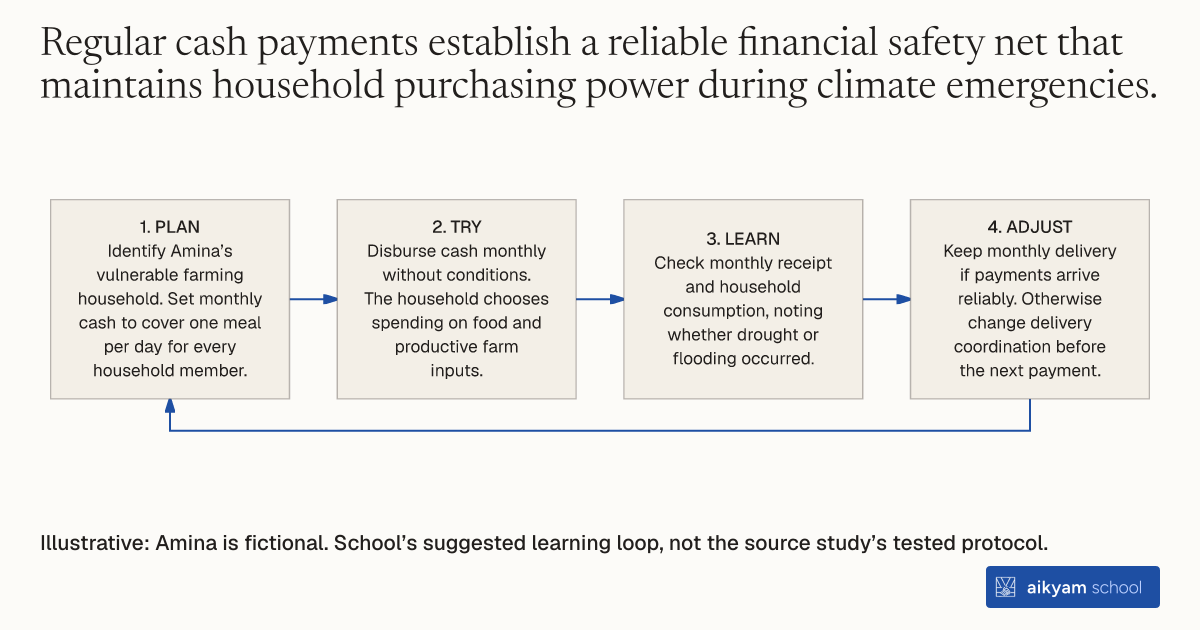
Try, learn and adjust
Check monthly cash supports household consumption
- Plan: Identify Amina’s vulnerable farming household. Set monthly cash to cover one meal per day for every household member.
- Try: Disburse cash monthly without conditions. The household chooses spending on food and productive farm inputs.
- Learn: Check monthly receipt and household consumption, noting whether drought or flooding occurred.
- Adjust: Keep monthly delivery if payments arrive reliably. Otherwise change delivery coordination before the next payment.
Illustrative: Amina is fictional. School’s suggested learning loop, not the source study’s tested protocol.
See source →School’s suggested learning loop: observe cash receipt, consumption and weather shocks; this is not an estimate of consumption effects.
How
When to use
Severe weather shocks reduce crop yields and household income in rural communities. This method provides baseline financial assistance to protect basic living standards. It targets smallholder farming households in drought- and flood-prone agricultural zones.
Distribute monthly unconditional cash transfers to smallholder farming households to prevent consumption cuts during weather shocks.
- Program administrators identify vulnerable farming households in shock-prone rural areas.
- Program staff disburse unconditional cash payments to participating households once every month.
- Program managers calibrate transfer amounts to cover the cost of one meal per day for all household members.
- Recipient households spend transfer funds on daily food consumption and productive agricultural inputs like fertilizer.
Why it works
This cash cushion prevents families from cutting food intake or liquidating productive farm assets when harvests fail.
Example
In Zambia, researchers evaluated rural farming households receiving monthly unconditional cash transfers sized to cover one meal per day for all household members. Recipients increased their total consumption by roughly 20 percent. During a drought or flood, recipient consumption stayed 3 percent higher than non-recipient households experiencing the same shock.
About the study
Participants
Smallholder farming households in rural Zambia facing weather shocks.
Study Design
Randomized controlled trial evaluating monthly unconditional cash transfers against an untreated control group during drought and flood events.
Results
Receiving monthly cash transfers increased total household consumption by roughly 20 percent. During droughts or floods, recipient consumption remained 3 percent higher than control households experiencing shocks. Recipients also increased their investment in productive inputs like fertilizer.