Research steps
Value food consumed from home production
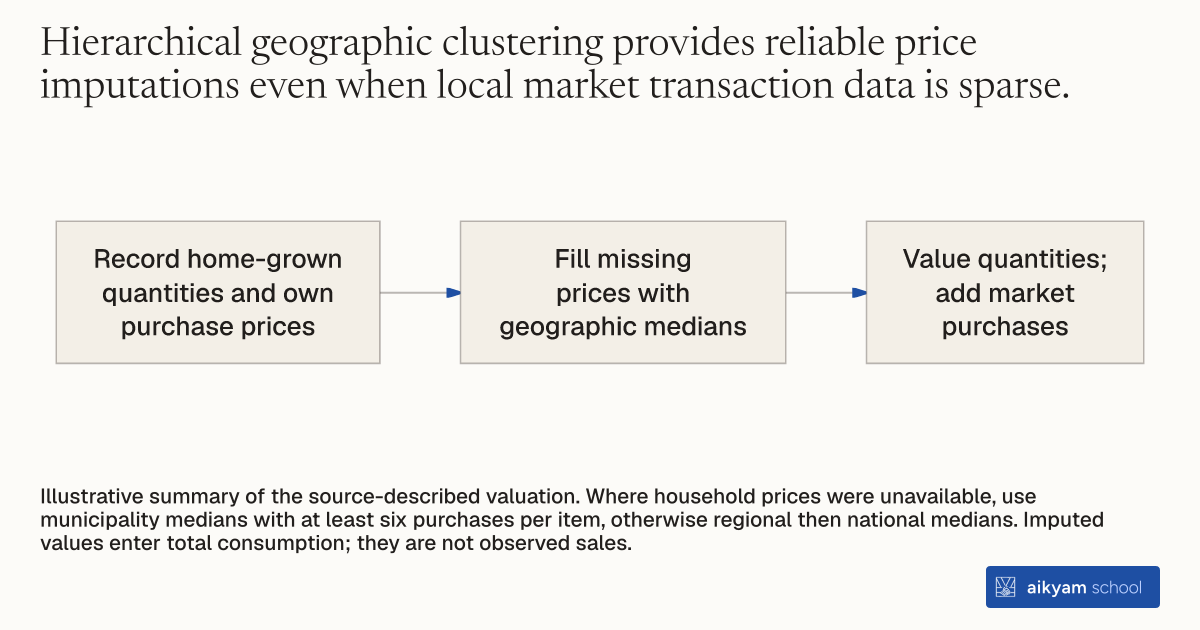
- Record home-grown quantities and own purchase prices
- Fill missing prices with geographic medians
- Value quantities; add market purchases
Illustrative summary of the source-described valuation. Where household prices were unavailable, use municipality medians with at least six purchases per item, otherwise regional then national medians. Imputed values enter total consumption; they are not observed sales.
See source →How
When to use
Poor rural households frequently consume home-grown crops and self-produced food alongside market purchases. Calculating total household living standards requires imputing monetary values for non-marketed produce when direct purchase prices are missing. Using median prices from local or regional geographic clusters provides reliable price estimates for valuing home consumption.
Impute monetary values for self-produced food consumption using median unit prices from surrounding geographic clusters.
- Collect household survey data on the quantities of food consumed from home production.
- Check whether the household purchased the identical food item to obtain a household-level price.
- Calculate median item prices across purchasing households in the municipality when household-level prices are unavailable.
- Set a minimum threshold of 6 purchasing observations per municipality per food item for local price validity.
- Aggregate to regional or national clusters to compute median unit prices if local observations fall below 6.
- Multiply self-produced consumption quantities by the calculated cluster median price to impute item monetary value.
- Sum imputed self-produced values and direct market purchases to construct the total household consumption aggregate.
Why it works
Using median prices rather than means prevents extreme local price outliers from distorting household welfare measurements.
Example
Researchers evaluating the Macedonian Conditional Cash Transfer program in 2010 and 2012 constructed total non-durable consumption aggregates for 1053 households. To value self-produced food, analysts derived median unit prices starting at the municipality level with a minimum of 6 purchase records, substituting regional or national median prices when local transactions were fewer.
About the study
Participants
1053 households with children aged 14 to 18 sampled at baseline across 84 municipalities in Macedonia, with 830 households followed up after two years. Households averaged 4.5 members and 55 percent were Muslim.
Study Design
A randomized trial across all 84 municipalities in Macedonia, stratified by population size into 42 mother-recipient municipalities and 42 household-head-recipient municipalities. Surveys collected baseline data in 2010 and follow-up data in 2012.
Results
Constructing comprehensive consumption aggregates revealed that food accounted for 55 percent of non-durable expenditures among recipient households. Directing cash transfers to mothers increased the household food budget share by 4 to 5 percentage points.