Research comparison
Compare output under different piece rates
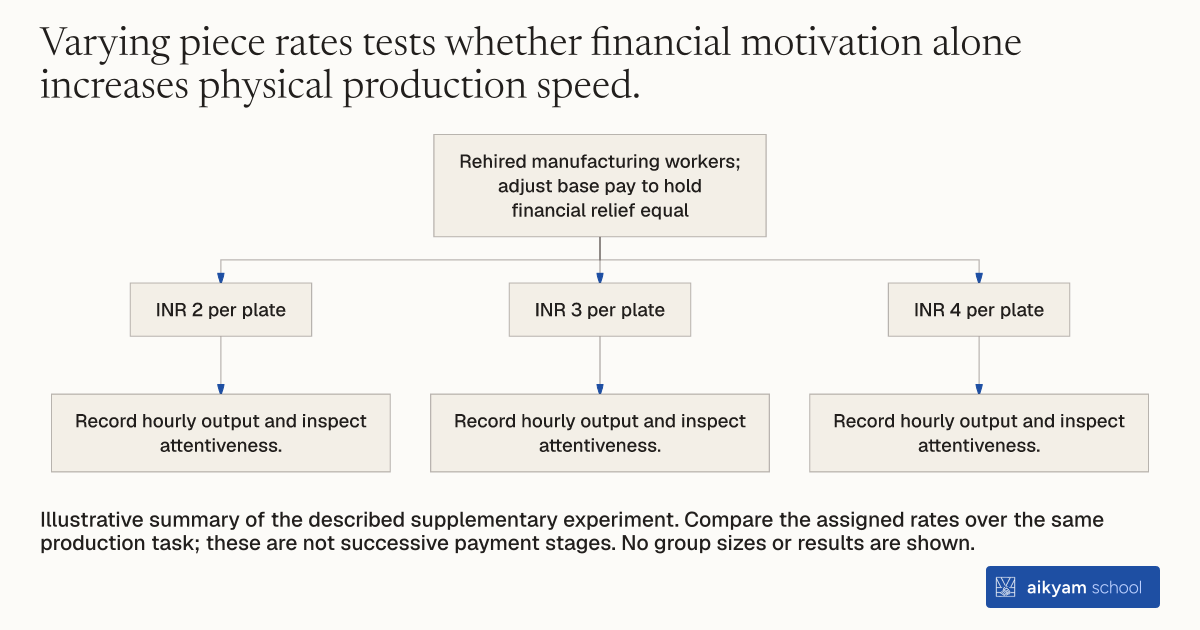
Rehired manufacturing workers; adjust base pay to hold financial relief equal
- INR 2 per plate
- Record hourly output and inspect attentiveness.
- INR 3 per plate
- Record hourly output and inspect attentiveness.
- INR 4 per plate
- Record hourly output and inspect attentiveness.
Illustrative summary of the described supplementary experiment. Compare the assigned rates over the same production task; these are not successive payment stages. No group sizes or results are shown.
See source →How
When to use
Employers often raise piece-rate incentives to boost worker output speed and production quantity. However, higher piece rates may fail to improve worker focus or attentiveness if underlying financial anxiety remains unaddressed. Evaluators vary piece rates while holding total income constant to isolate financial motivation from cognitive relief.
Vary unit piece-rate payment levels while adjusting base pay to isolate the impact of financial incentives on worker productivity and attentiveness.
- Rehire experienced manual manufacturing laborers for a secondary production contract.
- Assign workers to different piece-rate incentive tiers ranging from INR 2 ($0.03) to INR 4 ($0.06) per unit produced.
- Adjust guaranteed base pay across incentive groups so that total financial relief remains equal across tiers.
- Record hourly production output for each worker across the different piece-rate tiers.
- Inspect finished goods to measure whether higher piece-rate incentives change worker attentiveness.
Why it works
Holding overall income constant ensures that any performance change stems from piece-rate motivation rather than cognitive strain relief.
Example
In a supplementary experiment in Odisha, India, researchers rehired workers and varied piece-rate payments between INR 2, INR 3, and INR 4 per plate while adjusting base pay.
About the study
Participants
Rehired male manufacturing laborers aged 18–55 in Odisha, India.
Study Design
Randomized evaluation varying piece-rate incentives across INR 2, INR 3, and INR 4 per plate while holding overall financial relief constant to compare output speed and attentiveness against early pay interventions.
Results
Increasing piece-rate pay from INR 2 to INR 4 per plate modestly increased production speed by 0.036 plates per hour, but had no statistically significant impact on worker attentiveness.