Research measures
Measure several worker outcomes
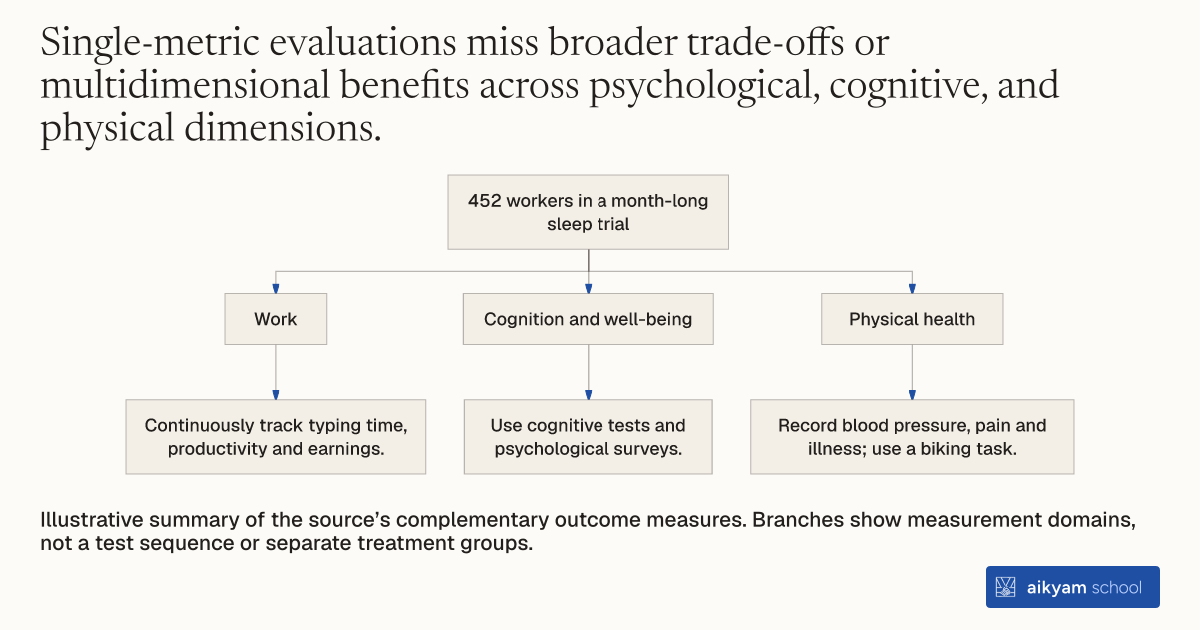
452 workers in a month-long sleep trial
- Work
- Continuously track typing time, productivity and earnings.
- Cognition and well-being
- Use cognitive tests and psychological surveys.
- Physical health
- Record blood pressure, pain and illness; use a biking task.
Illustrative summary of the source’s complementary outcome measures. Branches show measurement domains, not a test sequence or separate treatment groups.
See source →How
When to use
Evaluating health interventions requires measuring changes across diverse dimensions of human performance beyond basic labor output. Administering a comprehensive battery of cognitive tests, psychological surveys, physical health metrics, and direct work tracking allows evaluators to determine holistic impacts. This method serves researchers and managers assessing how health or behavioral programs affect employee performance and overall well-being.
Administer a multi-domain testing battery to evaluate the physical, cognitive, psychological, and economic impacts of health interventions.
- Measure worker labor supply, productivity, and hourly earnings continuously through active data entry performance.
- Administer cognitive testing batteries evaluating worker attention, memory, and cognitive function.
- Survey psychological well-being using questions on daily happiness, stress levels, depression, life satisfaction, and sense of life possibilities.
- Assess physical health through blood pressure readings, self-reported pain, self-reported illness records, and daily living activities.
- Conduct physical stamina tests using a stationary biking task to measure exercise capacity and health changes.
Why it works
Combining real-time work tracking with objective clinical tests and standardized surveys isolates true intervention impacts from reporting bias.
Example
Researchers evaluated 452 low-income data entry workers in Chennai, India, across productivity, cognitive tests, psychological surveys, blood pressure, and stationary biking tasks to measure the effects of sleep interventions.
About the study
Participants
452 men and women from low-income neighborhoods in Chennai, India, with an average of 10 years of education.
Study Design
A randomized evaluation collecting multi-domain outcome data across a one-month trial combining computer task logging, lab cognitive batteries, physical health tests, and surveys.
Results
Workplace naps increased productivity by 2.3 percent, boosted overall earnings by 4.1 percent (INR 11 or US\$0.05 per day), and improved cognition and happiness, whereas nighttime sleep increases had no impact on cognition, productivity, or well-being.