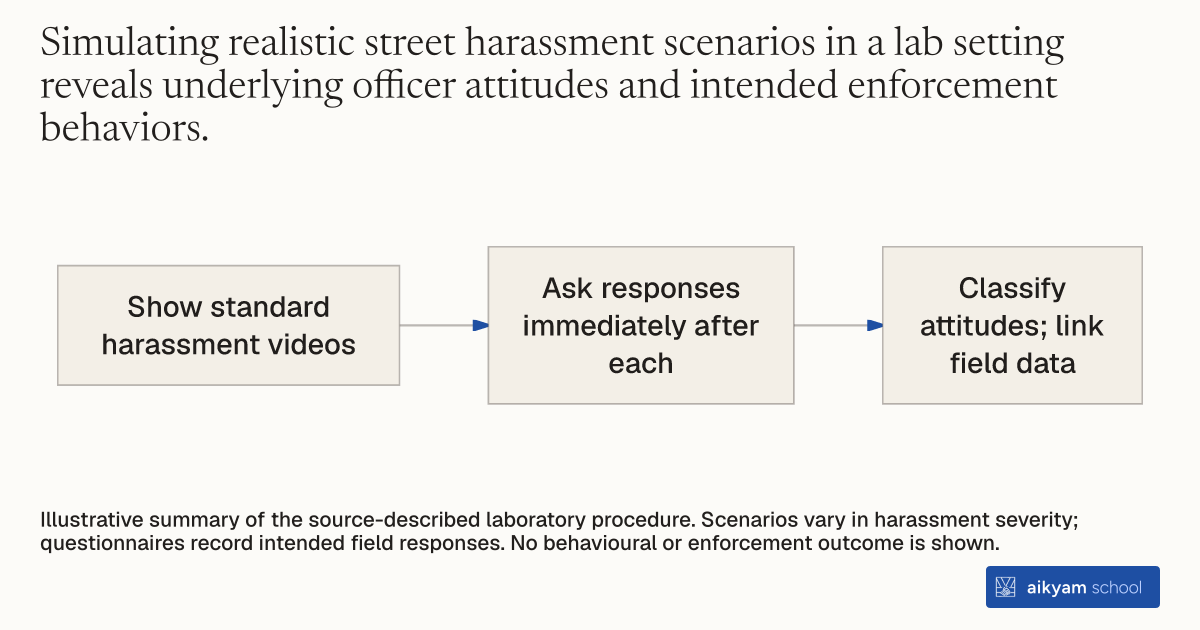
Research steps
Link video responses to patrol data
- Show standard harassment videos
- Ask responses immediately after each
- Classify attitudes; link field data
Illustrative summary of the source-described laboratory procedure. Scenarios vary in harassment severity; questionnaires record intended field responses. No behavioural or enforcement outcome is shown.
See source →How
When to use
Police officers' personal attitudes toward sexual harassment strongly influence their willingness to enforce laws and respond to incidents. Standard self-reported surveys may fail to predict how individual officers actually behave when confronted with street harassment. Conduct video scenario lab experiments with police officers to evaluate their intended responses to specific harassment situations.
Evaluate police officer responses to street harassment by conducting lab experiments using simulated video scenarios.
- Produce a series of standardized video scenarios depicting varying levels of public sexual harassment.
- Present the video scenarios to police officers participating in the evaluation.
- Instruct officers to view each harassment scenario in a controlled lab setting.
- Administer structured questionnaires immediately after each video to record how officers would respond in the field.
- Classify officers by attitude severity based on their responses to the depicted harassment situations.
- Link individual officer attitude classifications to field patrolling data to evaluate enforcement outcomes.
Why it works
Measuring officer attitude severity through video responses accurately predicts officer effectiveness in reducing harassment during field patrols.
Example
Researchers conducted lab experiments with Hyderabad City Police officers in Hyderabad, India, using video scenarios of harassment to measure individual officer attitudes and predict field patrol effectiveness.
About the study
Participants
Police officers in Hyderabad, India.
Study Design
Lab experiment where police officers viewed video scenarios depicting harassment and answered questions about their intended responses, linked to field patrol outcomes.
Results
Officers with harsher attitudes toward harassment identified via the lab experiment achieved a 12 percent reduction in recorded harassment cases when patrolling in uniform, including a 16 percent reduction in mild harassment cases.