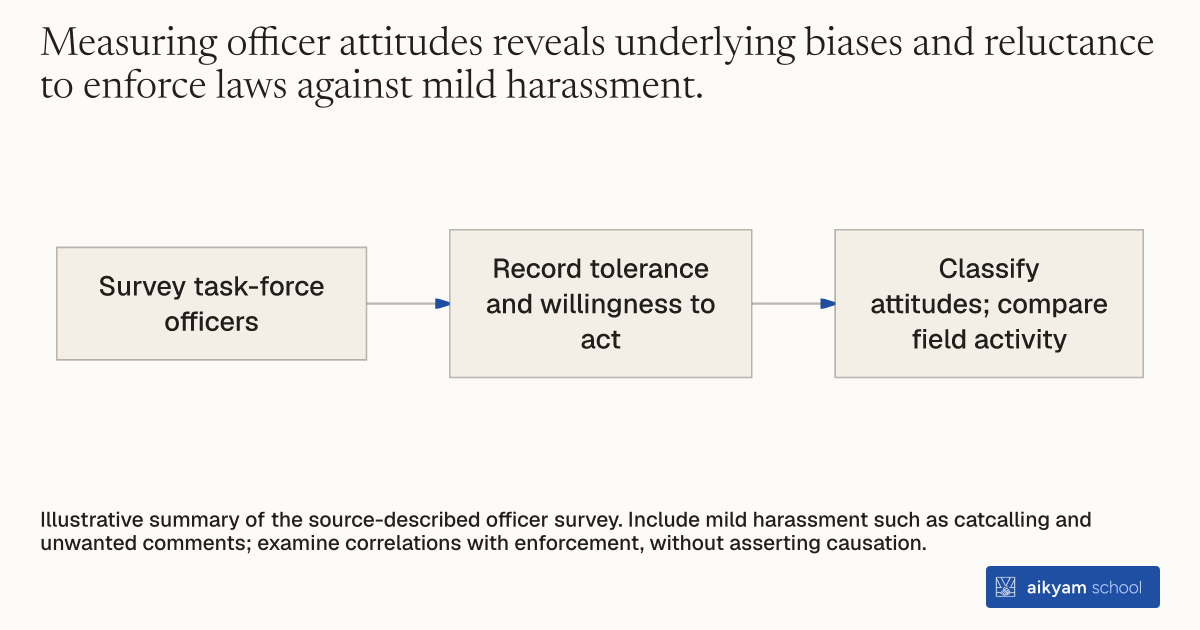
Research steps
Record officer attitudes and tolerance
- Survey task-force officers
- Record tolerance and willingness to act
- Classify attitudes; compare field activity
Illustrative summary of the source-described officer survey. Include mild harassment such as catcalling and unwanted comments; examine correlations with enforcement, without asserting causation.
See source →How
When to use
Law enforcement officers often hold personal attitudes and levels of tolerance that influence how strictly they enforce public safety laws. When addressing street harassment, individual officer reluctance to intervene in mild offenses leads to widespread inaction. Conduct officer surveys to measure baseline attitudes and tolerance toward sexual harassment across law enforcement personnel.
Survey police personnel directly to evaluate personal attitudes and tolerance levels toward public sexual harassment.
- Formulate survey items assessing officer perspectives on street harassment severity and appropriate law enforcement responses.
- Distribute the survey to officers assigned to specialized public safety task forces.
- Record officer willingness to intervene in mild harassment offenses like catcalling and unwanted comments.
- Measure officer tolerance levels toward public harassment behaviors across different scenarios.
- Categorize officers based on attitude severity to evaluate how personal beliefs correlate with field enforcement performance.
Why it works
Identifying officer tolerance levels allows police leadership to target training and predict enforcement effectiveness in patrolled areas.
Example
Researchers surveyed police officers from the Hyderabad City Police in Hyderabad, India, to assess their personal attitudes and tolerance toward street harassment during a randomized patrolling evaluation.
About the study
Participants
Police officers in Hyderabad, India.
Study Design
Surveying police officers to assess personal attitudes and tolerance toward harassment as part of a randomized controlled evaluation of public patrolling strategies.
Results
Surveys revealed that police officers generally showed reluctance to address mild forms of sexual harassment, directly contributing to inaction in such cases.