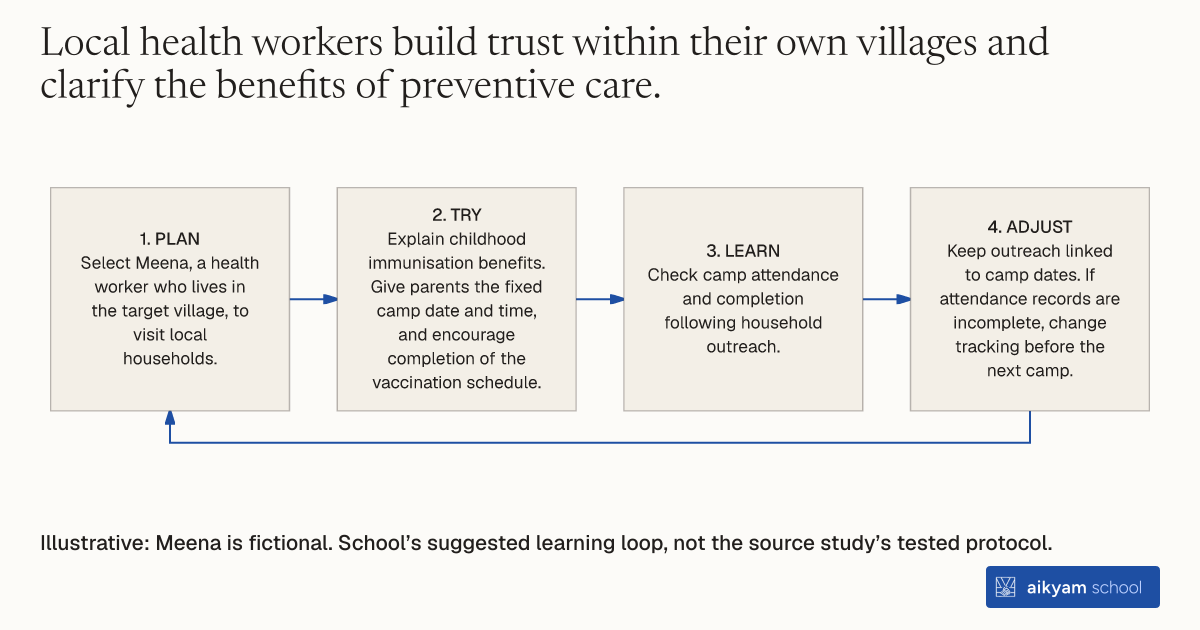
Try, learn and adjust
Check outreach explains camp dates and vaccination
- Plan: Select Meena, a health worker who lives in the target village, to visit local households.
- Try: Explain childhood immunisation benefits. Give parents the fixed camp date and time, and encourage completion of the vaccination schedule.
- Learn: Check camp attendance and completion following household outreach.
- Adjust: Keep outreach linked to camp dates. If attendance records are incomplete, change tracking before the next camp.
Illustrative: Meena is fictional. School’s suggested learning loop, not the source study’s tested protocol.
See source →School’s suggested learning loop: observe attendance and completion. The study tested outreach with reliable camps, not outreach alone.
How
When to use
Health programs in rural communities often face low vaccination coverage because parents lack information or hold weak beliefs about preventive care. Engaging local health workers to inform families helps bridge community trust and raise awareness about scheduled health services. This method helps health organizations engage local stakeholders to encourage families to vaccinate their children.
Deploy a local village health worker to build community awareness about immunization services.
- Select a local health worker residing in the target rural village.
- Task the health worker with visiting households throughout the village.
- Explain the benefits of childhood immunization to parents.
- Announce the fixed date and time of upcoming immunization camps to families.
- Encourage parents to bring their young children to complete their vaccination schedule.
Why it works
Announcing fixed dates and times removes uncertainty and helps parents plan for immunization visits.
Example
Seva Mandir assigned local village health workers to create awareness alongside reliable monthly immunization camps in rural Udaipur, Rajasthan. This awareness outreach combined with reliable camps increased full child immunization rates from 6% to 18%.
About the study
Participants
Poor tribal households with children aged 1 to 3 years across rural villages in Udaipur district, Rajasthan, India.
Study Design
A clustered randomized controlled evaluation comparing villages with reliable camps promoted by village health workers against control villages.
Results
Reliable immunization service with village health worker awareness outreach increased full child immunization rates from 6% to 18%.