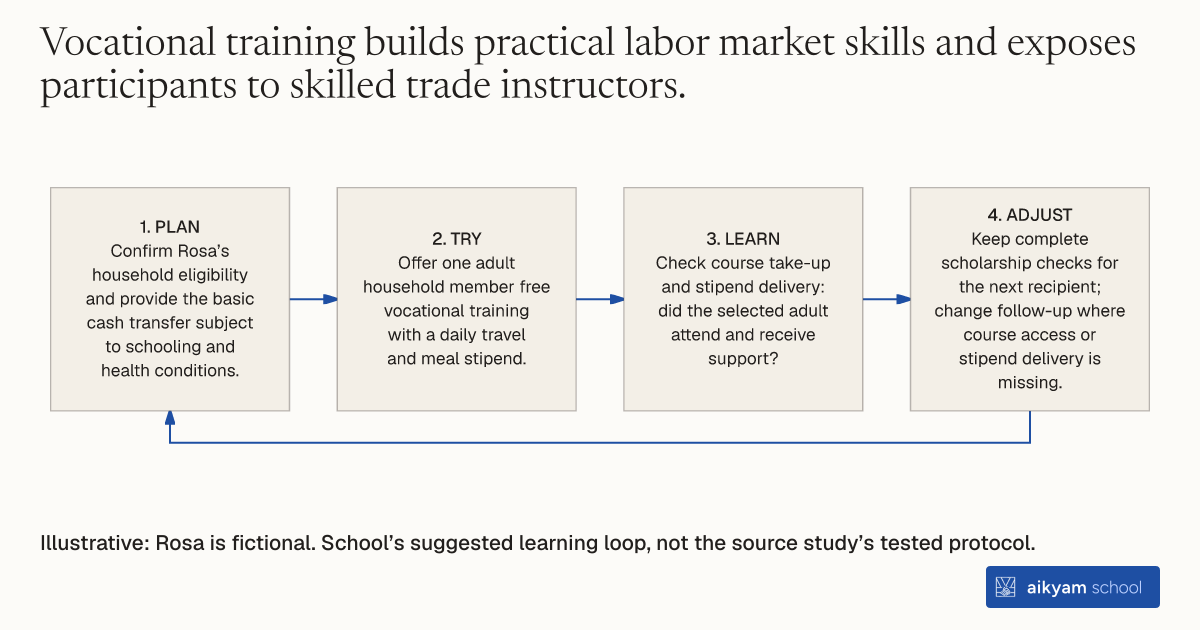
Try, learn and adjust
Check the training scholarship reaches an adult
- Plan: Confirm Rosa’s household eligibility and provide the basic cash transfer subject to schooling and health conditions.
- Try: Offer one adult household member free vocational training with a daily travel and meal stipend.
- Learn: Check course take-up and stipend delivery: did the selected adult attend and receive support?
- Adjust: Keep complete scholarship checks for the next recipient; change follow-up where course access or stipend delivery is missing.
Illustrative: Rosa is fictional. School’s suggested learning loop, not the source study’s tested protocol.
See source →School’s suggested, untested learning loop. Observe training take-up and daily support; no employment or income gain is assumed.
How
When to use
Poor rural households in developing regions often lack access to technical skills and vocational education. Low skill levels restrict adult family members to low-paying agricultural day labor and perpetuate low household income. Offer this intervention to low-income adult caregivers alongside conditional cash transfers to boost occupational skills.
Provide adult caregivers in poor rural households with a vocational training scholarship alongside basic conditional cash transfers.
- Select low-income households in target municipalities using a proxy means eligibility index.
- Deliver basic conditional cash transfers to female household heads upon meeting health and schooling conditions.
- Offer one adult household member a scholarship ticket for free enrollment in a local vocational training course.
- Organize training courses focused on practical labor market skills and technical development.
- Provide a daily stipend to cover travel expenses and meals during course attendance.
Why it works
Learning technical trades expands occupational aspirations and encourages families to prioritize formal education for their children.
Example
In 2006, the Ministry of the Family in Nicaragua offered vocational training scholarships to one-third of three thousand eligible rural households across six municipalities, achieving an eighty-nine percent course take-up rate among beneficiaries.
About the study
Participants
1,000 eligible poor households assigned to the training package out of 3,000 total eligible study households across 56 treatment communities in 6 municipalities of northwestern Nicaragua.
Study Design
Two-stage randomized controlled trial assigning communities to treatment or control, followed by public lottery assignment of transfer packages among registered beneficiaries.
Results
Program take-up for the vocational scholarship reached 89 percent, and exposure to leaders increased parental aspirations for children by 0.406 standard deviations.