Try, learn and adjust
Check whether scholarship courses have started
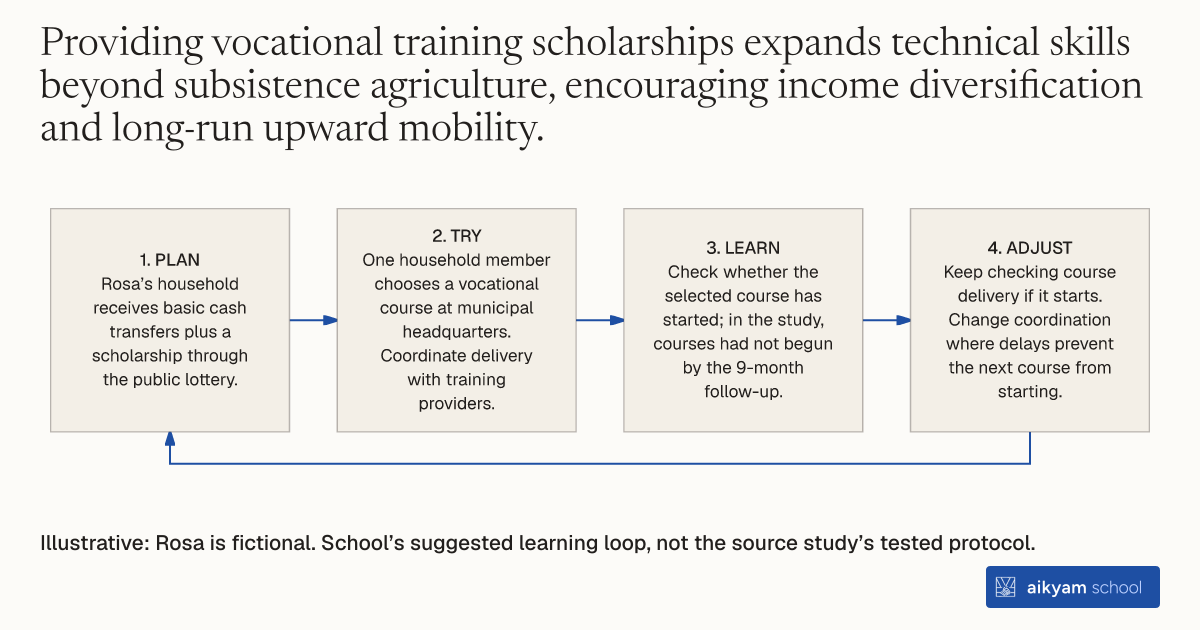
- Plan: Rosa’s household receives basic cash transfers plus a scholarship through the public lottery.
- Try: One household member chooses a vocational course at municipal headquarters. Coordinate delivery with training providers.
- Learn: Check whether the selected course has started; in the study, courses had not begun by the 9-month follow-up.
- Adjust: Keep checking course delivery if it starts. Change coordination where delays prevent the next course from starting.
Illustrative: Rosa is fictional. School’s suggested learning loop, not the source study’s tested protocol.
See source →School’s suggested, untested loop. Observe course choice and start dates. Early study impacts could not be attributed to training that had not started.
How
When to use
Rural households affected by drought shocks often lack nonagricultural job skills and income diversification opportunities. Offering vocational training scholarships allows household members to choose specialized occupational courses delivered at municipal headquarters. This builds technical skills needed for nonagricultural employment and long-run poverty reduction.
Provide occupational training scholarships and municipal course options to enable household members to acquire nonagricultural skills.
- Target impoverished rural households in drought-affected municipalities that meet proxy means poverty criteria.
- Select eligible households via participatory lotteries in community assemblies to receive the vocational training package.
- Combine basic conditional cash transfers with a scholarship designated for occupational skill development.
- Allow one member from each selected household to choose among vocational training courses offered in municipal headquarters.
- Coordinate with training providers in municipal headquarters to deliver specialized technical and occupational instruction.
Why it works
Combining training scholarships with cash transfers protects basic consumption while building human capital.
Example
In rural northwest Nicaragua, 1,000 eligible poor households across 56 intervention communities were randomly allocated the vocational training package—combining basic conditional cash transfers with an occupational scholarship—via participatory lotteries held during community registration assemblies.
About the study
Participants
1,000 poor households across 56 intervention communities in 6 rural municipalities in northwest Nicaragua with average annual per capita expenditure around 250 US dollars.
Study Design
Two-stage randomized controlled trial where communities were randomly assigned to treatment or control, followed by participatory lotteries assigning the vocational training scholarship package.
Results
Implementation delays prevented vocational training courses from starting before the 9-month follow-up survey, so early impacts reflected the basic conditional cash transfer components.