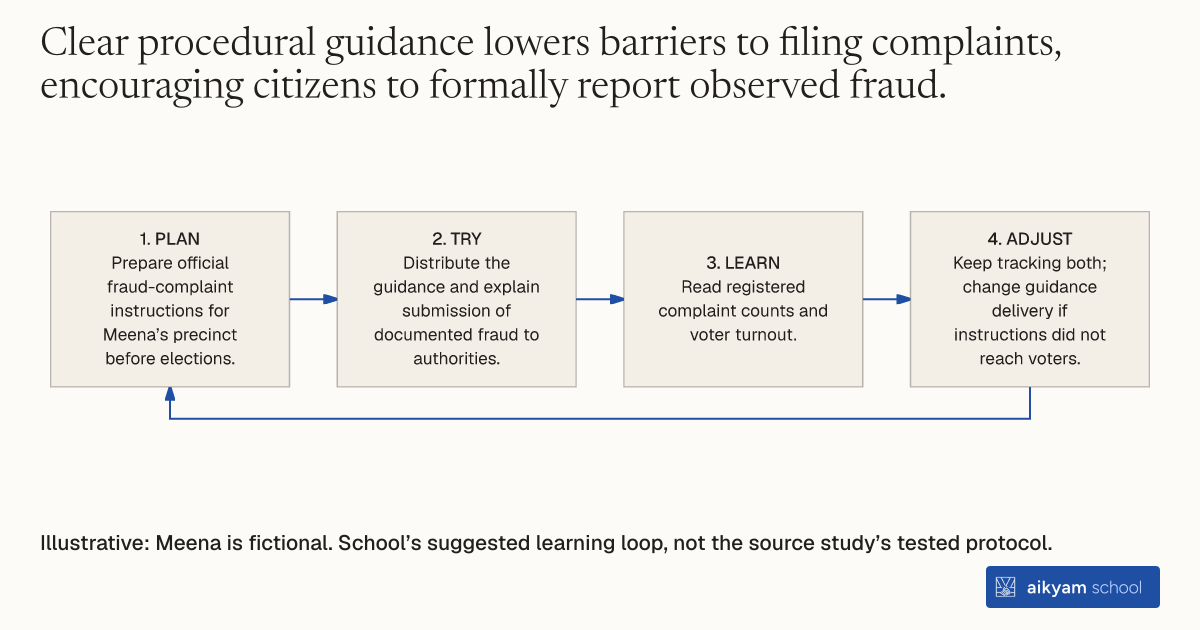
Try, learn and adjust
Check voters receive official complaint guidance
- Plan: Prepare official fraud-complaint instructions for Meena’s precinct before elections.
- Try: Distribute the guidance and explain submission of documented fraud to authorities.
- Learn: Read registered complaint counts and voter turnout.
- Adjust: Keep tracking both; change guidance delivery if instructions did not reach voters.
Illustrative: Meena is fictional. School’s suggested learning loop, not the source study’s tested protocol.
See source →Registered complaints and turnout. The Georgia campaign increased complaints but reduced turnout. School’s suggested learning loop, not a source-tested cycle.
How
When to use
Voters witness or experience voter fraud during elections but lack procedural knowledge to submit official complaints. Non-governmental organizations provide clear instructions on reporting irregularities to election authorities. This method helps civil society groups increase citizen oversight and formal reporting of electoral fraud.
Inform citizens on how to file official voter fraud complaints to increase formal reporting of electoral irregularities.
- Identify target election precincts prior to parliamentary elections.
- Draft educational guidance detailing official procedures for filing voter fraud complaints.
- Distribute the complaint filing instructions to citizens residing in program precincts.
- Advise voters to submit documented instances of election fraud to administrative authorities.
- Record registered complaints to monitor citizen reporting of electoral irregularities.
Why it works
In post-Soviet settings, voter guidance on state reporting mechanisms may also signal increased state scrutiny, leading some voters to abstain from turning out.
Example
During the 2008 parliamentary elections in Georgia, an NGO informed citizens in program precincts on how to file complaints of voter fraud; the campaign increased registered complaints but decreased voter turnout in those precincts.
About the study
Participants
Registered voters across voting precincts in Georgia during the 2008 parliamentary elections.
Study Design
Randomized field experiment assessing the impact of an NGO voter complaint information campaign against unexposed control precincts.
Results
Increased citizen activism as measured by registered complaints, while decreasing voter turnout in program precincts.