Research steps
Separate wage and hours contributions
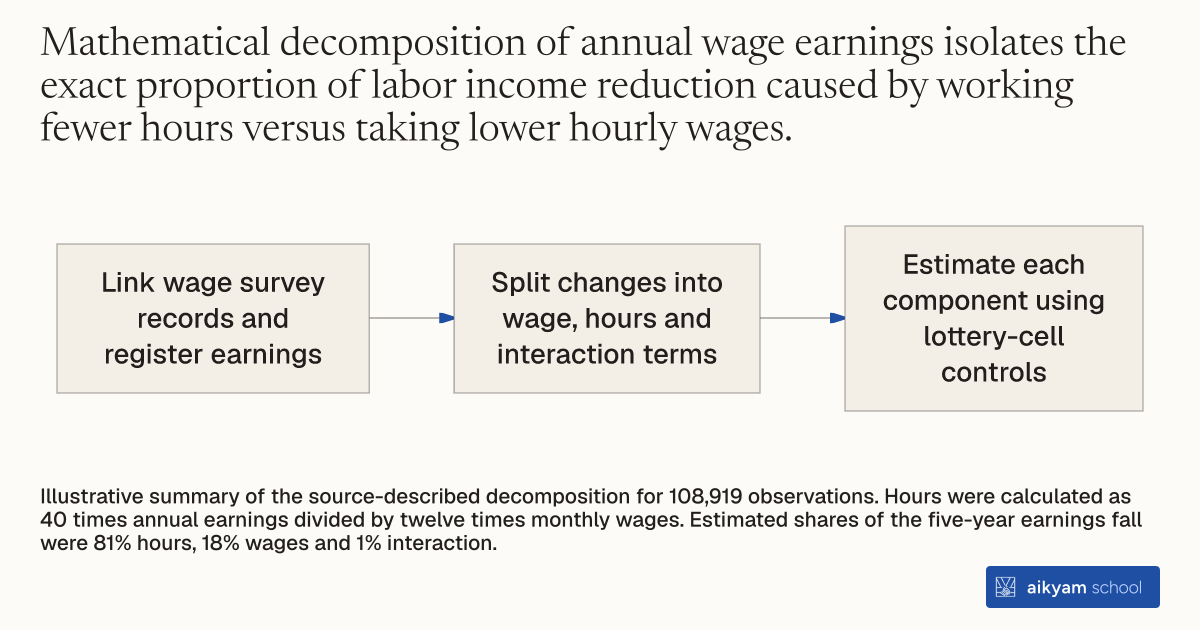
- Link wage survey records and register earnings
- Split changes into wage, hours and interaction terms
- Estimate each component using lottery-cell controls
Illustrative summary of the source-described decomposition for 108,919 observations. Hours were calculated as 40 times annual earnings divided by twelve times monthly wages. Estimated shares of the five-year earnings fall were 81% hours, 18% wages and 1% interaction.
See source →How
When to use
Researchers need to isolate whether an annual labor earnings response to a financial windfall is driven by reductions in hourly wage rates versus reductions in contractual working hours. Observing aggregate wage earnings alone masks whether workers cut back time on the job or transition into lower-paying employment positions. Decomposing wage earnings changes into wage rate and hours components using wage survey data isolates the primary channel of intensive margin labor supply adjustments.
Decompose annual wage earnings changes into distinct hourly wage rate and hours-worked components using longitudinal administrative wage survey data.
- Obtain worker full-time equivalent monthly wages and contracted weekly hours from Statistics Sweden annual wage survey records.
- Calculate earnings-based weekly hours worked by scaling 40 hours by annual register wage earnings divided by twelve times the contracted monthly wage.
- Compute baseline pre-lottery wage earnings for each worker one year prior to the lottery event.
- Express annual wage earnings changes as the sum of three components: wage rate change times baseline hours, baseline wage rate times hours change, and the interaction term between wage and hours changes.
- Estimate panel regressions using each component as the dependent variable while controlling for cell fixed effects and baseline pre-lottery wage earnings.
- Calculate the percentage share of the overall wage earnings reduction attributable to hours worked, wage rate, and interaction components.
Why it works
Applying this decomposition to administrative survey panel data removes ambiguity regarding intensive-margin workforce adjustments.
Example
In Sweden, researchers evaluated 108,919 wage-hours survey observations of lottery winners, finding that reduced working hours accounted for 81 percent of the total five-year drop in wage earnings, while wage rate changes accounted for 18 percent.
About the study
Participants
108,919 observations from the Statistics Sweden annual wage survey subsample of Swedish lottery winners aged 21 to 64.
Study Design
OLS panel regression estimating five-year labor supply adjustments using a three-part mathematical wage earnings decomposition while controlling for lottery cell fixed effects and baseline earnings.
Results
A 1M SEK prize reduces weekly working hours by 1.282 hours (p < 0.001) and monthly full-time equivalent wage by 147.3 SEK (p = 0.080); reduced working hours account for 81 percent of the five-year wage earnings drop, while wage rate changes account for 18 percent and interaction terms account for 1 percent.