Try, learn and adjust
Check appliance rebates and water use
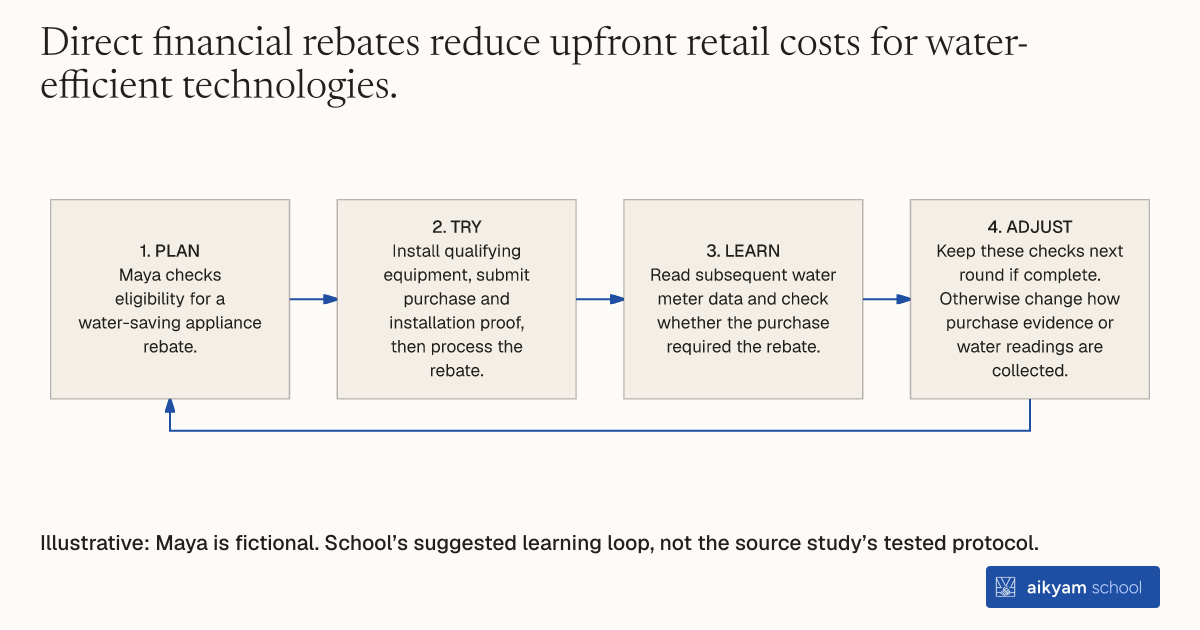
- Plan: Maya checks eligibility for a water-saving appliance rebate.
- Try: Install qualifying equipment, submit purchase and installation proof, then process the rebate.
- Learn: Read subsequent water meter data and check whether the purchase required the rebate.
- Adjust: Keep these checks next round if complete. Otherwise change how purchase evidence or water readings are collected.
Illustrative: Maya is fictional. School’s suggested learning loop, not the source study’s tested protocol.
See source →School’s suggested, untested learning loop. Observe installation proof, rebate payment and water use; some purchases would occur without incentives.
How
When to use
Municipalities face growing water demand and urban supply constraints. High purchasing costs deter residential utility customers from upgrading to water-efficient household fixtures and appliances. Offering rebate programs lowers upfront equipment expenses to encourage water-saving technology adoption.
Provide financial rebates to residential utility customers who purchase and install water-saving technologies.
- Design municipal utility rebate schedules covering high-efficiency toilets, washing machines, and smart irrigation controllers.
- Distribute rebate applications and eligibility guidelines to residential water customers.
- Require households to submit proof of purchase and installation for qualifying water-saving equipment.
- Process municipal rebate disbursements directly to participating residential property owners.
- Track residential water meter readings following appliance upgrades to measure post-installation water savings.
Why it works
Lowering purchase barriers prompts households to replace older, high-volume fixtures with efficient appliances that reduce long-term utility consumption.
Example
Residential water customers in Cary, North Carolina, and Burbank, California, received rebate incentives to install high-efficiency toilets, washing machines, and irrigation controllers. The rebate programs successfully reduced overall residential water consumption across participating households, though high-efficiency toilet subsidies exhibited lower additionality.
About the study
Participants
Residential water customers in Cary, North Carolina, and Burbank, Southern California, across four evaluations.
Study Design
Difference-in-differences and quasi-experimental propensity score matching evaluating household water meter records.
Results
Rebate programs for water-saving technologies consistently reduced residential water consumption. Some programs successfully encouraged purchases that would not have occurred otherwise, while other appliance incentives, particularly for high-efficiency toilets, demonstrated lower additionality.