Try, learn and adjust
Check pump owners install and monitor pipes
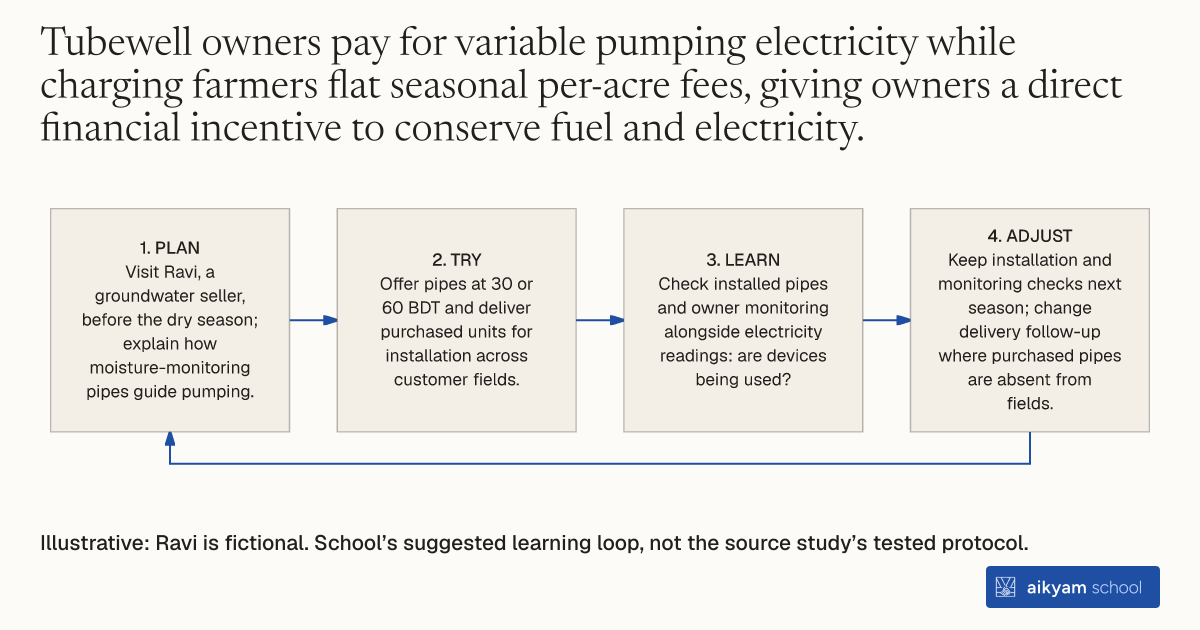
- Plan: Visit Ravi, a groundwater seller, before the dry season; explain how moisture-monitoring pipes guide pumping.
- Try: Offer pipes at 30 or 60 BDT and deliver purchased units for installation across customer fields.
- Learn: Check installed pipes and owner monitoring alongside electricity readings: are devices being used?
- Adjust: Keep installation and monitoring checks next season; change delivery follow-up where purchased pipes are absent from fields.
Illustrative: Ravi is fictional. School’s suggested learning loop, not the source study’s tested protocol.
See source →School’s suggested, untested learning loop. Observe purchases, installation, monitoring and pump electricity; no saving is assumed for Ravi.
How
When to use
Smallholder farmers pay fixed seasonal water fees while monopolistic tubewell owners pay variable energy costs to pump groundwater. Delivering water-saving subsidies to end-user farmers fails to reduce pumping because farmers do not bear variable operating costs. Targeting subsidies directly to water sellers incentivizes owners to adopt conservation tools and oversee irrigation scheduling across command areas.
Deliver water-saving technology information and subsidized hardware directly to local groundwater pump owners prior to the irrigation season.
- Identify all active tubewell owners who sell groundwater to neighboring smallholder farmers before planting.
- Send an extension worker directly to the tubewell owner's house or pump station right before the dry season.
- Explain how Alternate Wetting and Drying plastic pipes measure subterranean moisture to reduce total required pumping hours.
- Offer the tubewell owner subsidized water-monitoring pipes at a discounted price of 30 or 60 BDT per pipe.
- Deliver the purchased pipes to the tubewell owner to install across customer fields in the command area.
- Re-visit tubewell owners before subsequent growing seasons to offer replacement or additional subsidized pipes.
Why it works
Targeting pump owners leverages their existing monitoring role over customer fields to ensure pipes are properly installed and checked.
Example
In 105 villages across Mymensingh and Kishoreganj, Bangladesh, enumerators targeted subsidies to tubewell owners, reducing pumping electricity consumption by 38 percent (1,775 kilowatt-hours per pump per year) in Year 2 without affecting rice yields.
About the study
Participants
N = 105 villages assigned to tubewell owner targeting out of 360 electric tubewell command areas serving 2,820 smallholder farmers in Bangladesh.
Study Design
Randomized Controlled Trial comparing tubewell owner targeting against door-to-door farmer targeting, village deliberation meetings, and control villages over two growing seasons, tracking pump electricity meters and pipe installation.
Results
Direct owner targeting increased tubewell owner pipe monitoring by 13.7 percentage points and decreased Year 2 electricity usage for pumping by 38 percent (-0.478 log points, ~1,775 kWh saved per pump annually).