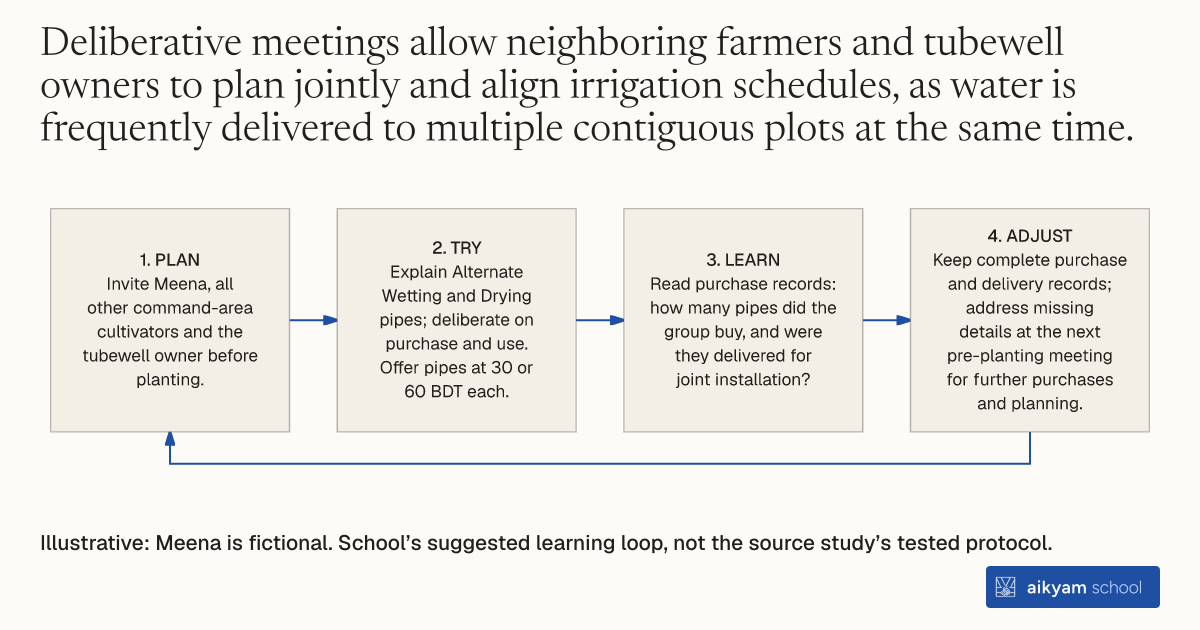
Try, learn and adjust
Check joint irrigation decisions and pipe purchases
- Plan: Invite Meena, all other command-area cultivators and the tubewell owner before planting.
- Try: Explain Alternate Wetting and Drying pipes; deliberate on purchase and use. Offer pipes at 30 or 60 BDT each.
- Learn: Read purchase records: how many pipes did the group buy, and were they delivered for joint installation?
- Adjust: Keep complete purchase and delivery records; address missing details at the next pre-planting meeting for further purchases and planning.
Illustrative: Meena is fictional. School’s suggested learning loop, not the source study’s tested protocol.
See source →School’s suggested learning loop, not a tested protocol. Observe group deliberation, pipe purchases and delivery, not assumed water savings.
How
When to use
Smallholder agricultural resource management often requires collective decision-making among adjacent farmers who share irrigation channels. Individual extension visits fail to facilitate joint adoption when water delivery serves multiple contiguous plots simultaneously. Organizing village deliberative meetings brings water-buying farmers and tubewell owners together to coordinate technology adoption and irrigation planning.
Convene community deliberation meetings with all land cultivators in an irrigation command area prior to planting to facilitate joint technology adoption.
- Send an enumerator or extension worker to invite all farmers and the tubewell owner in a command area to a village meeting right before the planting season.
- Convene the meeting in the village to explain the agronomic operation and water-saving benefits of Alternate Wetting and Drying pipes.
- Facilitate group deliberation among attending farmers and the tubewell owner on whether to purchase and how to use the pipes.
- Offer the perforated plastic pipes to attendees at a subsidized price of either 30 or 60 BDT per pipe.
- Record total group pipe purchases and deliver the hardware to purchasing farmers and owners for joint field installation.
- Repeat the community meeting in subsequent years before planting to allow additional purchases and continuous irrigation planning.
Example
In 105 villages across Mymensingh and Kishoreganj, Bangladesh, enumerators convened village meetings prior to boro rice planting, increasing initial pipe purchases by 2.21 pipes per village (a 20.8 percent increase over door-to-door sales of 10.65 pipes), though actual installed pipes and Year 2 electricity savings did not significantly exceed door-to-door sales.
About the study
Participants
N = 105 villages assigned to village meeting deliberation out of 360 electric tubewell command areas serving 2,820 smallholder farmers in Bangladesh.
Study Design
Randomized Controlled Trial comparing village deliberative meetings against individual door-to-door visits, tubewell owner visits, and control villages across two growing seasons, measuring sales, field installations, and pump electricity meter logs.
Results
Village meetings increased Year 1 pipe sales by 2.21 pipes per village relative to door-to-door sales (10.65 pipes), but installed pipes (0.79 additional installed pipes, p = 0.146) and Year 2 electricity reductions (-0.304 log points, p = 0.171) were not statistically different from door-to-door farmer targeting.