Try, learn and adjust
Check receipt of weekly farm advice
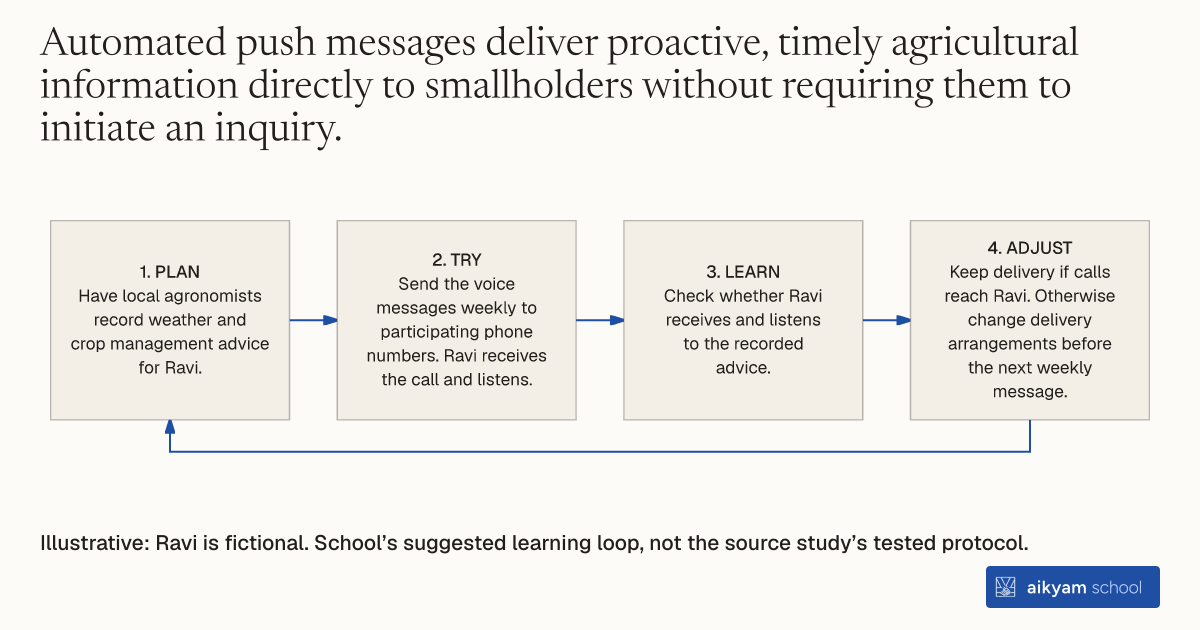
- Plan: Have local agronomists record weather and crop management advice for Ravi.
- Try: Send the voice messages weekly to participating phone numbers. Ravi receives the call and listens.
- Learn: Check whether Ravi receives and listens to the recorded advice.
- Adjust: Keep delivery if calls reach Ravi. Otherwise change delivery arrangements before the next weekly message.
Illustrative: Ravi is fictional. School’s suggested learning loop, not the source study’s tested protocol.
See source →School’s suggested learning loop, not the source’s tested procedure. Observe voice message receipt and listening. Effects reported for the mobile service do not isolate voice messages.
How
When to use
Smallholder farmers in rural areas often lack timely information about weather forecasts, pest threats, and crop management practices. Traditional agricultural extension visits are infrequent and struggle to deliver proactive updates throughout the growing season. This method delivers regular, push-based agricultural advice directly to farmers' mobile phones.
Deliver weekly automated voice messages providing agricultural advice and weather updates directly to smallholder mobile phones.
- The managing organization partners with local agronomists experienced in regional crop practices.
- The agronomists record concise audio messages covering upcoming weather conditions and crop management recommendations.
- The delivery system broadcasts these automated voice messages weekly to participating smallholder phone numbers.
- Farmers receive incoming automated calls and listen to the recorded agricultural advice on their mobile phones.
Why it works
Spoken voice messages overcome literacy barriers and ensure farmers stay informed about shifting weather and pest risks.
Example
In Ahmedabad, Gujarat, participating households received weekly information and tips via automated voice messages alongside access to the Avaaj Otalo hotline. Over two years, farmers receiving the mobile service were 12.5 percent more likely than the comparison group to adopt recommended technologies and purchase recommended seeds.
About the study
Participants
1,200 farmers across 40 villages in Ahmedabad, Gujarat, India; farmers averaged 46 years old, had approximately four years of education, and owned roughly six acres of land.
Study Design
Randomized Controlled Trial evaluating households offered mobile agricultural extension (including weekly automated voice messages) against a comparison group receiving no extension.
Results
Farmers offered the service were 66 percentage points more likely to gather agricultural information via mobile phones and 12.5 percent more likely to adopt recommended seeds relative to the comparison group.