Research steps
Redeem lottery winnings on the next visit
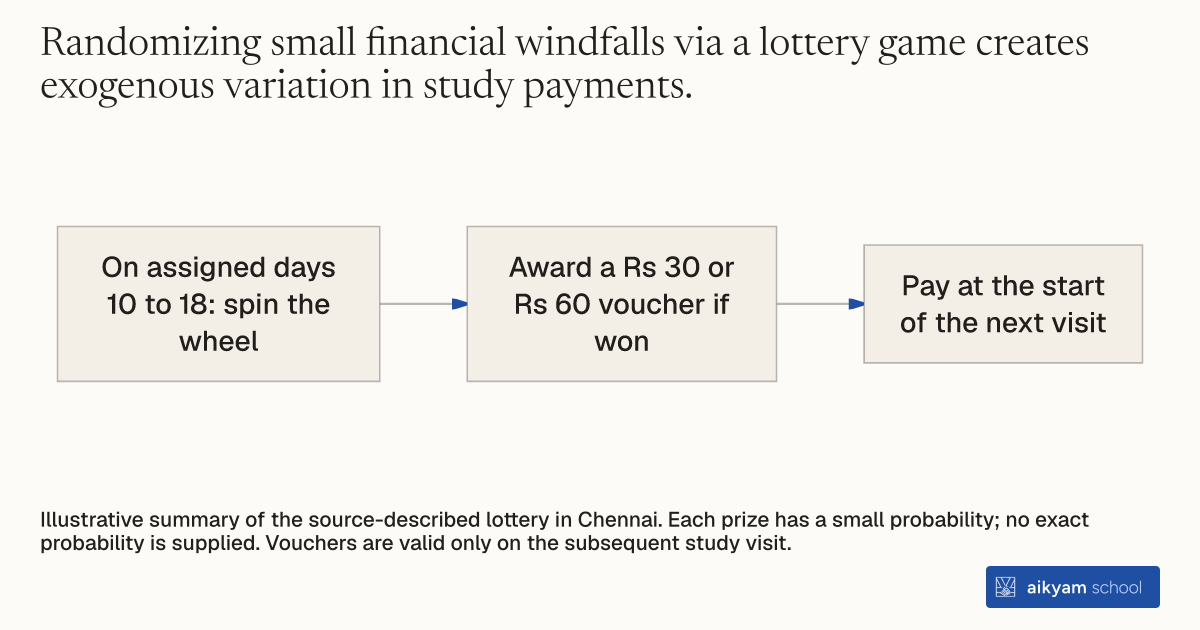
- On assigned days 10 to 18: spin the wheel
- Award a Rs 30 or Rs 60 voucher if won
- Pay at the start of the next visit
Illustrative summary of the source-described lottery in Chennai. Each prize has a small probability; no exact probability is supplied. Vouchers are valid only on the subsequent study visit.
See source →How
When to use
Field studies require exogenous variation in monetary payouts to estimate participants' marginal propensity to save out of unearned liquidity. Standard fixed daily payments do not allow researchers to isolate income shocks from baseline attendance earnings. Use this method to administer randomized financial bonuses using interactive lottery mechanisms.
Administer a daily probabilistic lottery game to study participants arriving at a field office to generate exogenous variations in daily financial payments.
- Field surveyors invite study participants arriving at the study office on assigned days (days 10 through 18) to participate in a lottery.
- Surveyors instruct participants to spin a physical wheel of fortune during their office visit.
- Surveyors award winning participants a voucher for Rs 30 or Rs 60 with a small probability based on the wheel spin.
- Surveyors inform winning participants that the voucher is valid only on their subsequent study office visit.
- Surveyors disburse the cash equivalent of the voucher at the beginning of the participant's subsequent study visit upon presentation of the valid voucher.
Why it works
This allows researchers to estimate the marginal propensity to save out of unexpected cash gains without altering baseline labor supply or daily baseline compensation.
Example
In Chennai, study surveyors offered cycle-rickshaw drivers attending daily office visits between days 10 and 18 the opportunity to spin a wheel of fortune for vouchers of Rs 30 or Rs 60 redeemable on their next visit. These randomized lottery windfalls allowed the researcher to estimate a marginal propensity to save of 0.16 to 0.19 in the control group and 0.30 to 0.40 in the pooled alcohol treatment groups.
About the study
Participants
229 male cycle-rickshaw drivers aged 25 to 60 in Chennai, India.
Study Design
Randomized lottery payment mechanism administered during office visits on study days 10 through 18 to estimate the marginal propensity to save out of windfall payments.
Results
Wheel of fortune lottery vouchers generated exogenous payment variation, yielding an estimated marginal propensity to save of 0.16 to 0.19 in the control group and 0.30 to 0.40 in the alcohol treatment groups.