Research procedure
Score school management practices
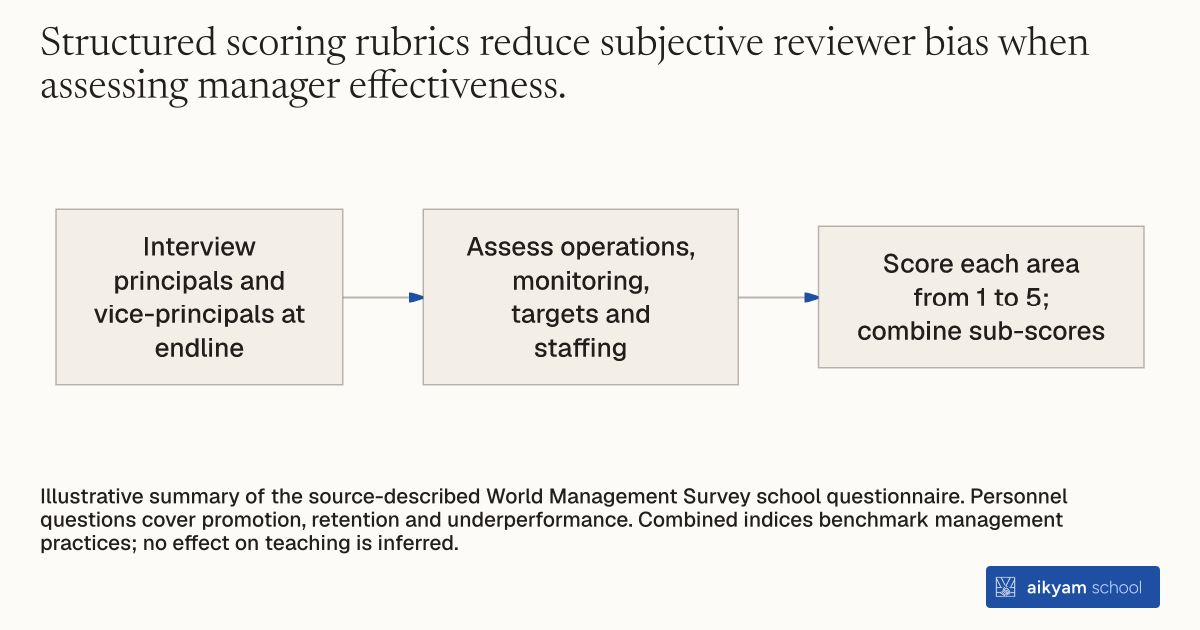
- Interview principals and vice-principals at endline
- Assess operations, monitoring, targets and staffing
- Score each area from 1 to 5; combine sub-scores
Illustrative summary of the source-described World Management Survey school questionnaire. Personnel questions cover promotion, retention and underperformance. Combined indices benchmark management practices; no effect on teaching is inferred.
See source →How
When to use
Schools often lack standard ways to evaluate whether school leadership practices drive institutional effectiveness and teacher performance. Informal administrative reviews fail to benchmark administrative capacity across operations and staff supervision. This method evaluates school administrative practices across structured dimensions to assess organizational execution capability.
Measure school management quality by interviewing school administrators using the standardized World Management Survey instrument.
- Schedule endline interviews with school principals and vice-principals across participating educational branches.
- Administer structured open-ended questionnaire items assessing operations management, performance monitoring, and target setting.
- Evaluate personnel management practices, focusing on worker promotion, retention, and handling of underperforming staff.
- Score administrative responses on a 1-to-5 standardized rubric across operations and people management sub-dimensions.
- Aggregate individual sub-scores into overall management capability indices to benchmark administrative practices against external educational systems.
Why it works
Benchmarking specific leadership behaviors identifies whether administrative capacity enables effective contract and personnel policy implementation.
Example
Researchers assessed school management practices across 189 principals and vice-principals in a Pakistani private school network during endline evaluation surveys. The surveyed principals achieved an overall management score of 4.27 out of 5, including 4.14 in people management and 4.32 in operations management. Higher baseline administrative capability supported effective implementation of performance pay structures across participating schools.
About the study
Participants
189 principals and vice-principals managing private schools with 5,698 teachers across Pakistan; 72 percent of principals were female.
Study Design
Survey-based administrative evaluation using the World Management Survey tool integrated into the endline data collection of a randomized controlled trial.
Results
Principals achieved an overall management score of 4.27 out of 5 (SD 0.43), a people management score of 4.14 (SD 0.53), and an operations management score of 4.32 (SD 0.61).