In Simple Words
Instead of asking individuals to remember and report exact yearly income numbers from a decade ago, researchers obtain signed consent to link survey profiles directly to official government tax records. This creates an unalterable, objective earnings ledger covering years before and after a financial event.
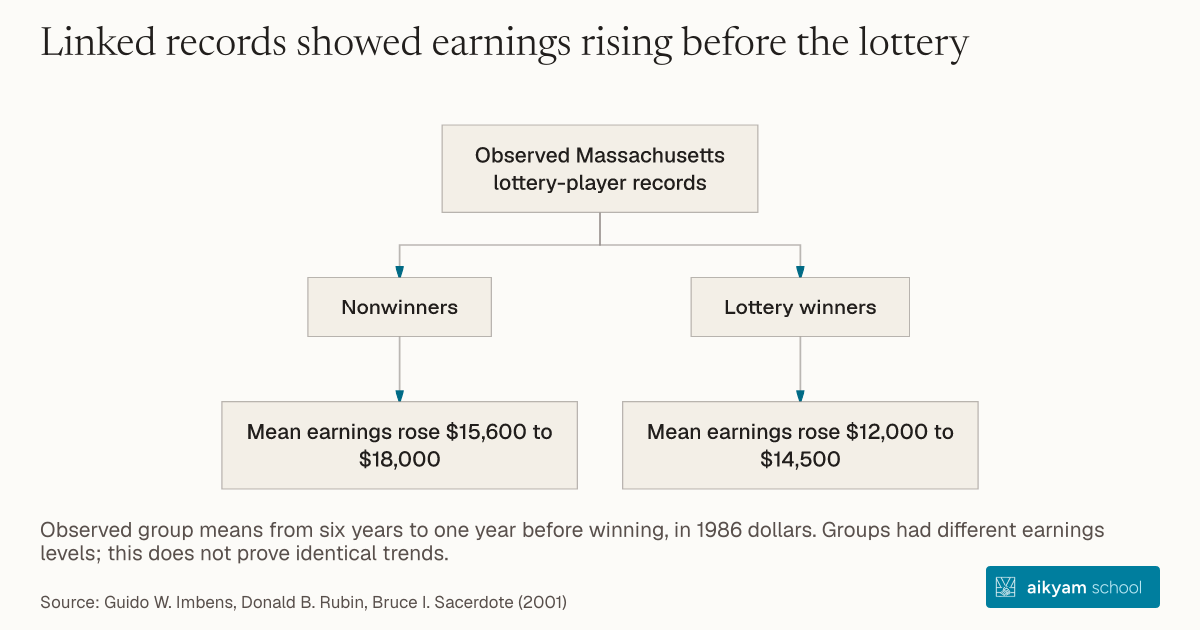
Observed Massachusetts lottery-player records
- Nonwinners
- Mean earnings rose $15,600 to $18,000
- Lottery winners
- Mean earnings rose $12,000 to $14,500
Observed group means from six years to one year before winning, in 1986 dollars. Groups had different earnings levels; this does not prove identical trends.
See source →Research question
Self-reported income survey data is highly vulnerable to recall error, intentional misreporting, and panel attrition over multi-year periods. Obtaining precise, objective longitudinal labor market data is necessary to reliably measure economic responses to policy interventions or wealth shocks.
Participants
N = 496 human Massachusetts lottery players (259 nonwinners, 237 winners) who signed Social Security authorization releases.
Study Design
Written authorization forms collected during survey administration were linked directly to Social Security Administration (SSA) records, establishing a 13-year continuous panel (6 years pre-lottery, winning year 0, and 6 years post-lottery).
Results
Administrative linkage secured 100% verified annual earnings histories across 13 consecutive years per individual, confirming pre-lottery earnings parallel trends between nonwinners ($15,600 to $18,000) and winners ($12,000 to $14,500) while eliminating recall measurement bias.
Takeaway
1. Incorporate signed administrative record consent releases in survey protocols to replace self-reported retrospective income questions with official government earnings panels.
Source and citation
See source →Read alongside the research
Plain-English glossary
Original explanations, informed by the references below. Examples are illustrations, not data from the studies above. The research text stays unchanged.
- Longitudinal study
A study that checks the same group of people at different times. This lets researchers examine how things change over time.
ExampleResearchers ask the same workers about their wellbeing at the start, after three months and after six months.
NICE · Longitudinal study ↗Read more about longitudinal study →