In Simple Words
If local schools keep messy graduation records, researchers can check the registry of a mandatory national college entrance test that 90% of high school graduates take. Showing up for the national exam serves as a concrete, objective proof that a student completed secondary schooling.
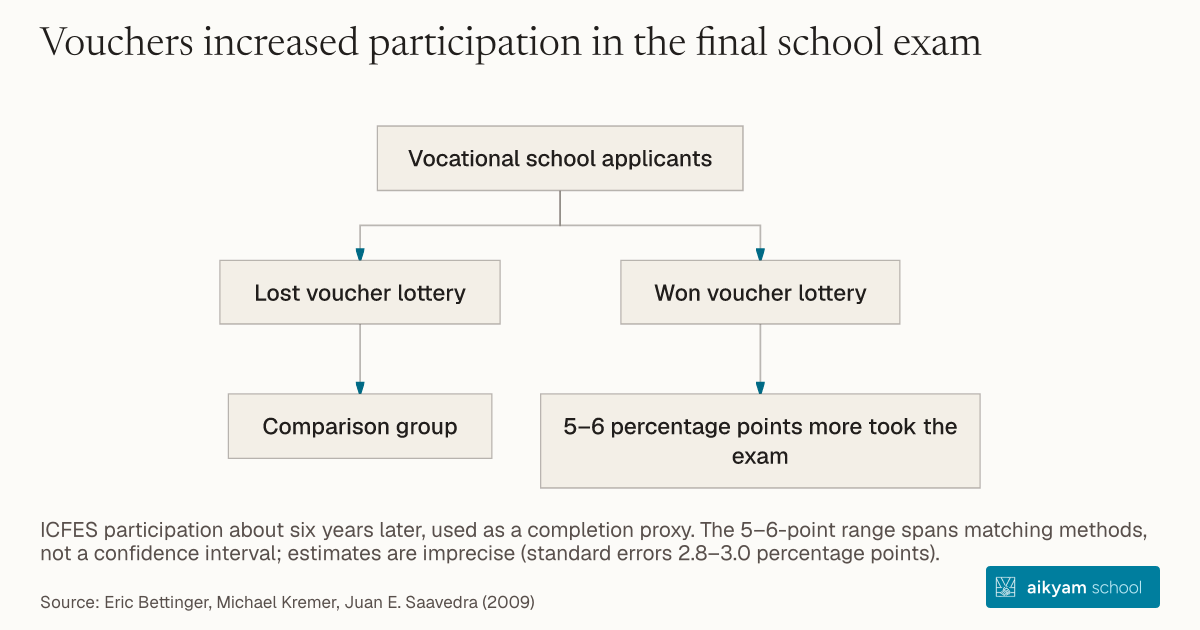
Vocational school applicants
- Lost voucher lottery
- Comparison group
- Won voucher lottery
- 5–6 percentage points more took the exam
ICFES participation about six years later, used as a completion proxy. The 5–6-point range spans matching methods, not a confidence interval; estimates are imprecise (standard errors 2.8–3.0 percentage points).
See source →Research question
Measuring secondary school completion rates in developing nations is frequently hampered by unreliable local school tracking and incomplete administrative identification records.
Participants
N = 3,422 human secondary school voucher applicants (1995 cohort) matched to administrative test records in Bogotá, Colombia.
Study Design
Longitudinal matching of randomized lottery records to national college entrance exam (ICFES) administrative registries using multi-stage ID, city, and name matching algorithms.
Results
Because 90% of high school graduates sit for the ICFES exam, registration served as a high-precision proxy for high school completion, revealing that vocational voucher winners were 5 to 6 percentage points (a 25% relative increase) more likely to complete secondary school than losers.
Takeaway
Utilize national standardized exam administrative registries as primary proxies for high school completion in contexts with incomplete school-level administrative records.
Source and citation
See source →Read alongside the research
Plain-English glossary
Original explanations, informed by the references below. Examples are illustrations, not data from the studies above. The research text stays unchanged.
- Longitudinal study
A study that checks the same group of people at different times. This lets researchers examine how things change over time.
ExampleResearchers ask the same workers about their wellbeing at the start, after three months and after six months.
NICE · Longitudinal study ↗Read more about longitudinal study →- Percentage points
The difference between two percentages.
ExampleA rise from 40% to 50% is 10 percentage points. Relative to the starting value, that is a 25% increase.
Office for National Statistics · Percentages ↗Read more about percentage points →