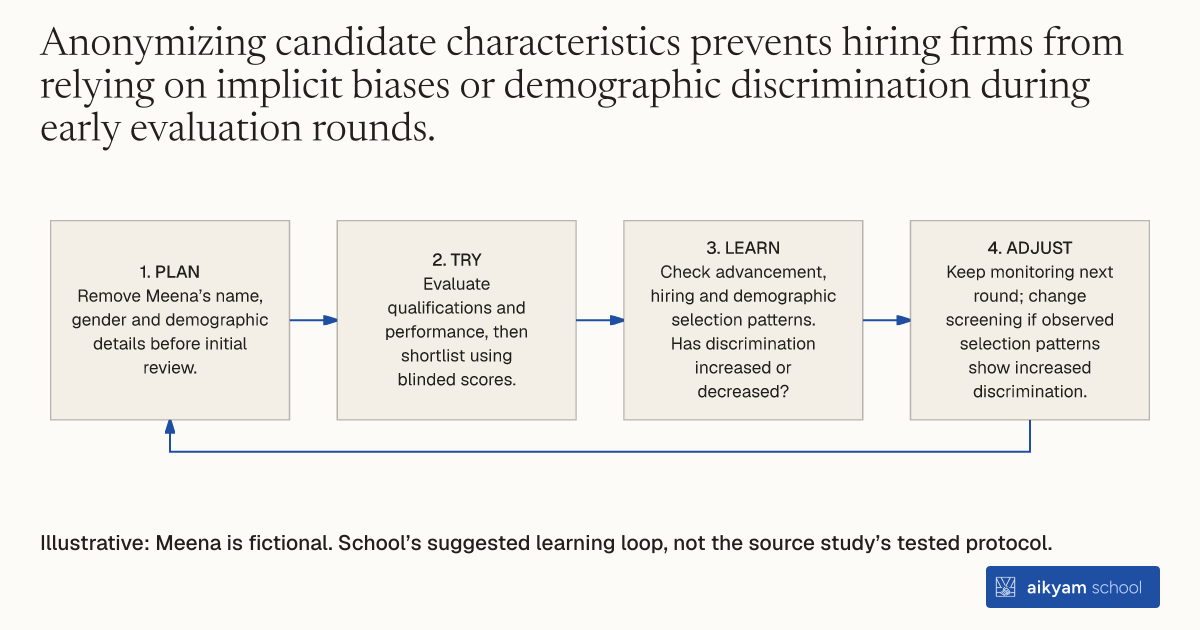
Try, learn and adjust
Check anonymous applicant screening
- Plan: Remove Meena’s name, gender and demographic details before initial review.
- Try: Evaluate qualifications and performance, then shortlist using blinded scores.
- Learn: Check advancement, hiring and demographic selection patterns. Has discrimination increased or decreased?
- Adjust: Keep monitoring next round; change screening if observed selection patterns show increased discrimination.
Illustrative: Meena is fictional. School’s suggested learning loop, not the source study’s tested protocol.
See source →School’s suggested, untested loop. Observe selection patterns and hiring. The source reports both improved representation and increased discrimination in different settings.
How
When to use
Underrepresented candidate groups often face hiring discrimination when demographic markers like gender and race are visible to employers. Hiding candidate demographic identity during initial recruitment prevents bias from influencing evaluator judgment. Anonymizing selection mechanisms helps organizations increase hiring opportunities for disadvantaged applicants.
Implement anonymized selection mechanisms that remove candidate demographic identity during initial applicant screening.
- Recruitment officers review job evaluation criteria and identify demographic markers on applicant records.
- Program administrators remove candidate names, gender indicators, and demographic characteristics from application materials prior to review.
- Hiring managers evaluate anonymized candidate profiles solely on objective qualifications and performance metrics.
- Selection panels shortlist candidates for follow-up interviews based on blinded evaluation scores.
- Program officers track participant advancement rates, hiring outcomes, and demographic selection patterns.
Why it works
This creates an impartial screening environment that allows underrepresented workers to advance based on merit.
Example
In major symphony orchestras, implementing blind audition mechanisms where judges could not observe applicant gender increased the probability that female musicians advanced from preliminary rounds and secured permanent positions.
Source
See source →Evidence in Labor Market Policies and Implications for Brazil: Job Search Assistance
Copyright © 2023 Inter-American Development Bank.
Full source notice
Copyright © 2023 Inter-American Development Bank ("IDB"). This work is subject to a Creative Commons license CC BY 3.0 IGO (https://creativecommons.org/licenses/by/3.0/igo/legalcode). The terms and conditions indicated in the URL link must be met and the respective recognition must be granted to the IDB. Further to section 8 of the above license, any mediation relating to disputes arising under such license shall be conducted in accordance with the WIPO Mediation Rules. Any dispute related to the use of the works of the IDB that cannot be settled amicably shall be submitted to arbitration pursuant to the United Nations Commission on International Trade Law (UNCITRAL) rules. The use of the IDB's name for any purpose other than for attribution, and the use of IDB's logo shall be subject to a separate written license agreement between the IDB and the user and is not authorized as part of this license. Note that the URL link includes terms and conditions that are an integral part of this license.