In Simple Words
Think of social restrictions like elastic bands placed around individuals. If the band is very loose (unrestricted groups), business training adds little new leverage because individuals already participate freely in the market. If the band is extremely tight (severely restricted groups), training alone cannot break the restraint. However, for individuals bound by moderate social constraints, peer-supported training provides just enough extra leverage to overcome the barrier and expand market activity.
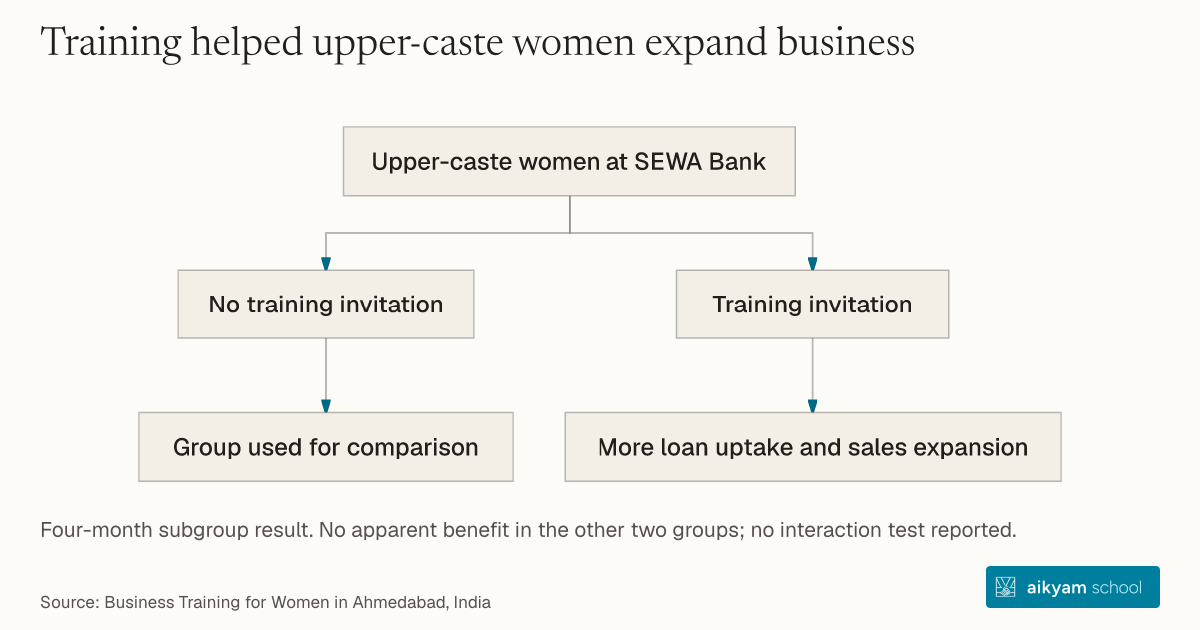
Upper-caste women at SEWA Bank
- No training invitation
- Group used for comparison
- Training invitation
- More loan uptake and sales expansion
Training increased loan uptake and sales expansion in the upper-caste subgroup. The source does not establish a causal restriction threshold. Four-month subgroup result. No apparent benefit in the other two groups; no interaction test reported.
See source →Research question
The impact of economic empowerment interventions on female micro-entrepreneurs varies non-linearly according to the severity of traditional religious and caste-based social restrictions.
Participants
N = 636 female micro-entrepreneurs aged 18–50 across Muslim, upper-caste Hindu, and scheduled-caste Hindu groups in Ahmedabad, India.
Study Design
Randomized controlled trial evaluating sub-group intervention effects across distinct caste and religious social norm strata over a four-month period.
Results
Business growth effects (increased loan uptake and sales expansion) were heavily concentrated among upper-caste Hindu women facing moderate social restrictions. Training produced no significant business expansion among Muslim women facing extreme social restrictions or among scheduled-caste Hindu women who faced lower baseline social restrictions.
Takeaway
Target peer-assisted entrepreneurial interventions primarily at moderately restricted demographic groups where peer support provides sufficient social capital to cross economic participation thresholds.
Source and citation
See source →Read alongside the research
Plain-English glossary
Original explanations, informed by the references below. Examples are illustrations, not data from the studies above. The research text stays unchanged.
- Baseline
The starting measurements in a study. Researchers use these to compare what participants were like at the start with what happens later.
ExampleBefore a training programme starts, researchers measure workers’ earnings. That first measurement is the baseline.
GET-IT glossary · Baseline characteristics ↗Read more about baseline →- Randomized controlled trial
A study that uses chance, like drawing lots, to decide who receives each option being compared. Researchers compare the groups’ outcomes to estimate the effect of those options.
ExampleA lottery assigns volunteers to a training programme or a comparison group. Researchers then compare their outcomes.
GET-IT glossary · Randomized study ↗Read more about randomized controlled trial →