In Simple Words
Post-intervention learning decay occurs because temporary educational boosts fade when continuous reinforcement stops, much like physical stamina drops back toward baseline when structured training sessions are discontinued.
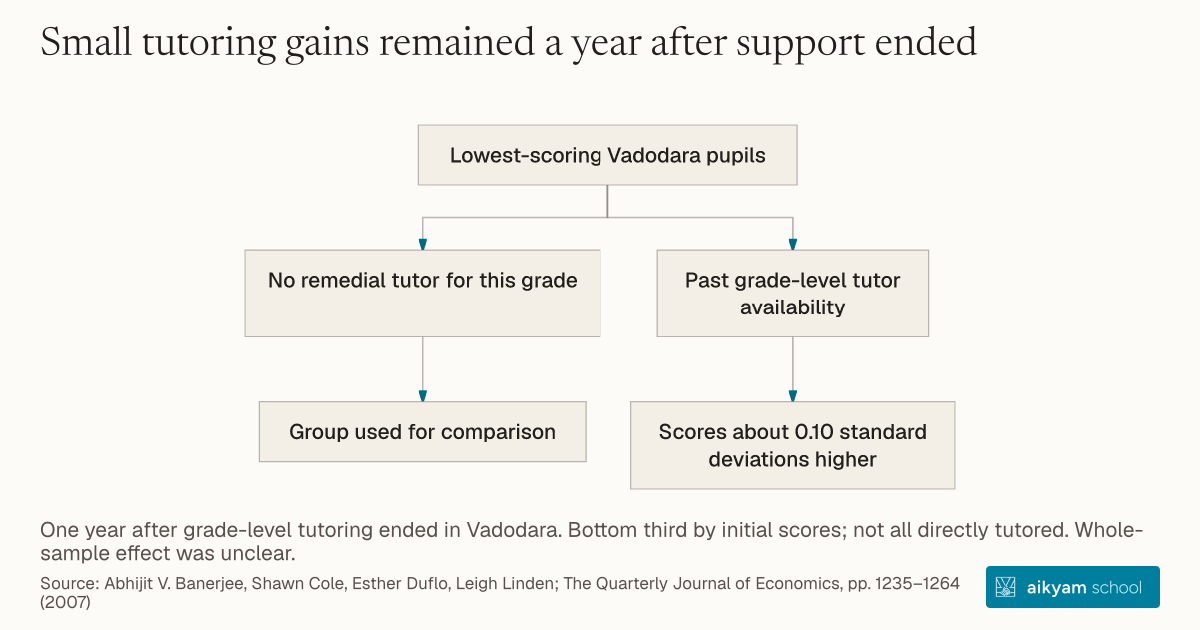
Lowest-scoring Vadodara pupils
- No remedial tutor for this grade
- Group used for comparison
- Past grade-level tutor availability
- Scores about 0.10 standard deviations higher
One year after grade-level tutoring ended in Vadodara. Bottom third by initial scores; not all directly tutored. Whole-sample effect was unclear.
See source →Research question
Educational interventions often generate substantial initial learning gains during active implementation, but these gains frequently decay once specialized support and supplementary inputs cease.
Participants
N = 9,925 primary school students tracked one year after intervention termination in Vadodara, India.
Study Design
Longitudinal follow-up Randomized Controlled Trial (RCT) measuring test score persistence one year after program completion.
Results
Initial short-term learning gains decayed to approximately 0.10 standard deviations for targeted low-scoring students in remedial education and 0.09 standard deviations in math for computer-assisted learning one year post-program.
Takeaway
Design multi-year educational programs that maintain level-targeted support across consecutive grades rather than relying on one-year temporary interventions.
Source and citation
See source →Read alongside the research
Plain-English glossary
Original explanations, informed by the references below. Examples are illustrations, not data from the studies above. The research text stays unchanged.
- Longitudinal study
A study that checks the same group of people at different times. This lets researchers examine how things change over time.
ExampleResearchers ask the same workers about their wellbeing at the start, after three months and after six months.
NICE · Longitudinal study ↗Read more about longitudinal study →- Follow-up
Collecting more information about participants later in a study to see what has happened to them. The term can also mean the length of time researchers keep track of them.
ExampleResearchers interview the same workers three months after a programme ends. That later interview is a follow-up.
GET-IT glossary · Follow-up ↗Read more about follow-up →- Randomized controlled trial
A study that uses chance, like drawing lots, to decide who receives each option being compared. Researchers compare the groups’ outcomes to estimate the effect of those options.
ExampleA lottery assigns volunteers to a training programme or a comparison group. Researchers then compare their outcomes.
GET-IT glossary · Randomized study ↗Read more about randomized controlled trial →