Research steps
Track tutoring attendance across the school year
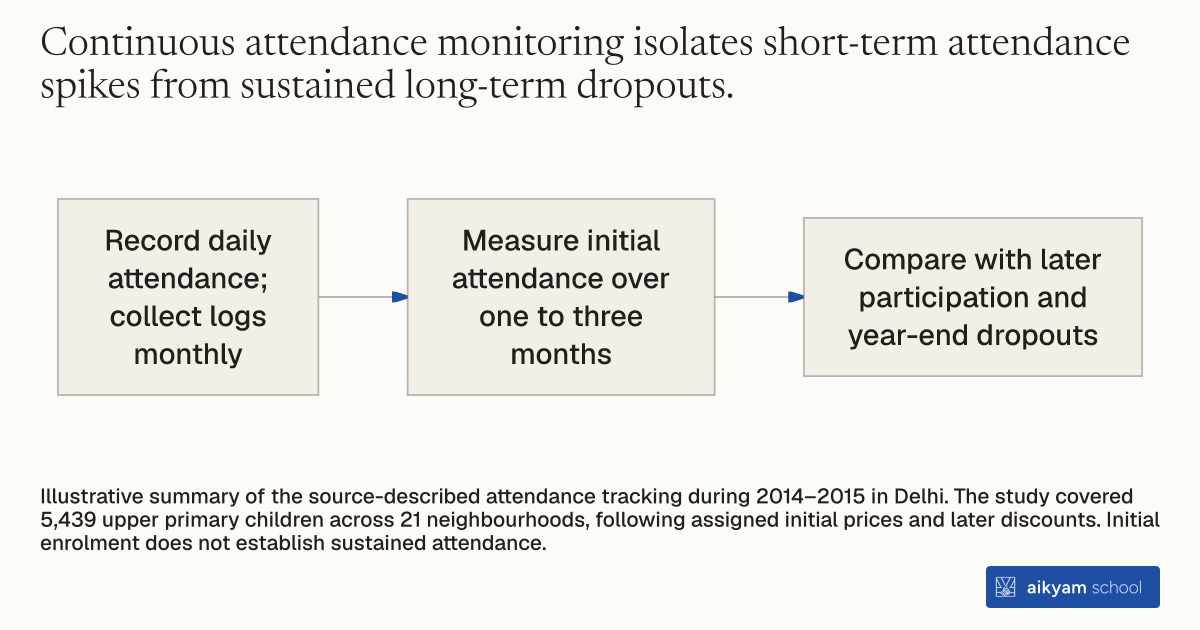
- Record daily attendance; collect logs monthly
- Measure initial attendance over one to three months
- Compare with later participation and year-end dropouts
Illustrative summary of the source-described attendance tracking during 2014–2015 in Delhi. The study covered 5,439 upper primary children across 21 neighbourhoods, following assigned initial prices and later discounts. Initial enrolment does not establish sustained attendance.
See source →How
When to use
Educational organizations operating fee-based programs often struggle to assess whether initial enrollment translates into sustained program participation. Short-term registration records fail to capture participant attrition caused by ongoing cost burdens. Long-term attendance tracking allows providers to measure student dropout rates across the entire academic year.
Track child attendance and program dropouts systematically across the full school year.
- Program staff record daily classroom attendance for all enrolled primary and upper primary students.
- Field staff collect attendance logs monthly throughout the school year.
- Analysts compute initial attendance rates during the first one to three months of instruction.
- Tutors identify students who stop attending sessions after two to three months.
- Researchers calculate long-term dropout rates by comparing initial attendance against cumulative year-end participation.
Why it works
This gives organizations clear evidence on how recurring fees affect ongoing student retention over time.
Example
Pratham tracked daily class attendance for 5,439 upper primary school children across 21 low-income Delhi neighborhoods throughout the 2014-2015 school year to measure retention and dropouts.
About the study
Participants
5,439 upper primary school children from 21 low-income neighborhoods in Delhi, India, where 10 percent attended private school and mothers averaged 3.7 years of education.
Study Design
Researchers conducted a randomized evaluation tracking student attendance and dropout rates across the 2014-2015 school year following assigned initial prices and mid-program discounts.
Results
Students agreeing to pay INR 100 or more had 6 percentage points higher initial attendance, but were 12 percentage points more likely to drop out after two to three months.