In Simple Words
Imagine giving a high-tech GPS navigation tool to a group of drivers; those who can read the manual use it to take faster, riskier shortcuts, while those who cannot read it stick strictly to the old, slow roads they already know.
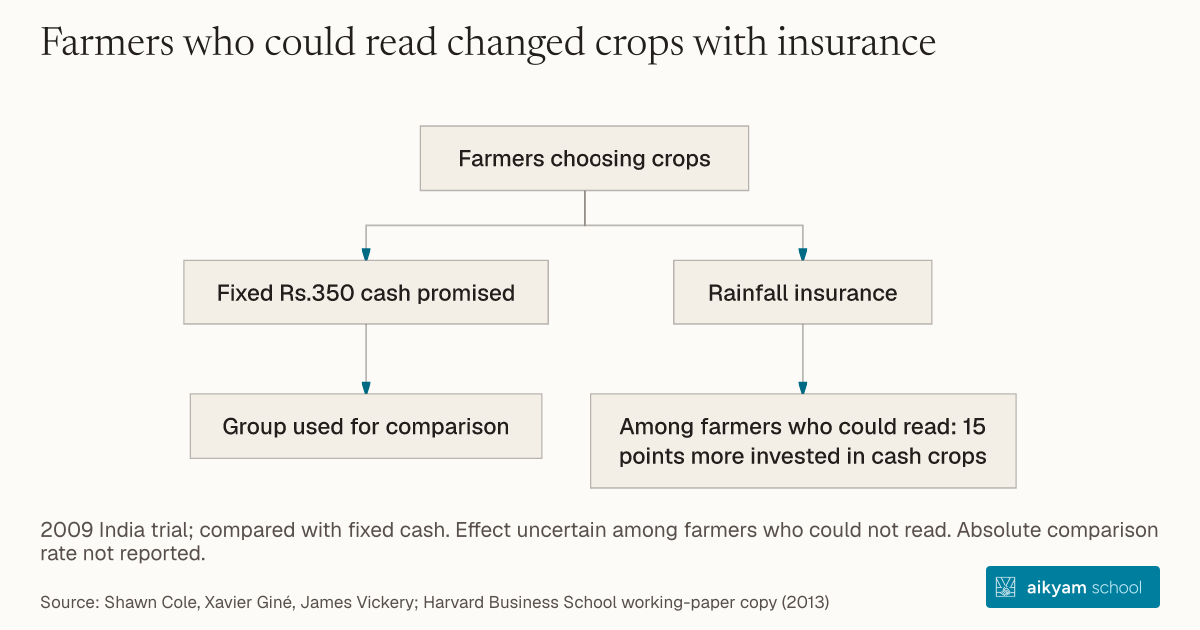
Farmers choosing crops
- Fixed Rs.350 cash promised
- Group used for comparison
- Rainfall insurance
- Among farmers who could read: 15 points more invested in cash crops
2009 India trial; compared with fixed cash. Effect uncertain among farmers who could not read. Absolute comparison rate not reported.
See source →Research question
The real production benefits of novel financial risk management instruments are often unevenly distributed across target populations due to disparities in basic literacy, product understanding, and trust.
Participants
N = 1,479 farming household heads in rural Andhra Pradesh, India (54% unschooled, 44% literate).
Study Design
Randomized Controlled Trial (RCT) interaction analysis measuring treatment effect variations across education levels (years of schooling and literacy status).
Results
Among literate farmers, assignment to the insurance treatment group increased cash crop investment likelihood by 15 percentage points, whereas among illiterate farmers, the treatment effect was statistically indistinguishable from zero.
Takeaway
Combine novel financial product rollouts with targeted financial literacy training and simplified product messaging to ensure equitable adoption among uneducated producers.
Source and citation
See source →Read alongside the research
Plain-English glossary
Original explanations, informed by the references below. Examples are illustrations, not data from the studies above. The research text stays unchanged.
- Percentage points
The difference between two percentages.
ExampleA rise from 40% to 50% is 10 percentage points. Relative to the starting value, that is a 25% increase.
Office for National Statistics · Percentages ↗Read more about percentage points →- Randomized controlled trial
A study that uses chance, like drawing lots, to decide who receives each option being compared. Researchers compare the groups’ outcomes to estimate the effect of those options.
ExampleA lottery assigns volunteers to a training programme or a comparison group. Researchers then compare their outcomes.
GET-IT glossary · Randomized study ↗Read more about randomized controlled trial →