In Simple Words
Financial literacy kiosk training works like giving someone driving lessons alongside a car key. Having a key is useless if a person does not know how to steer, but hands-on practice ensures a driver can navigate independently without asking for assistance.
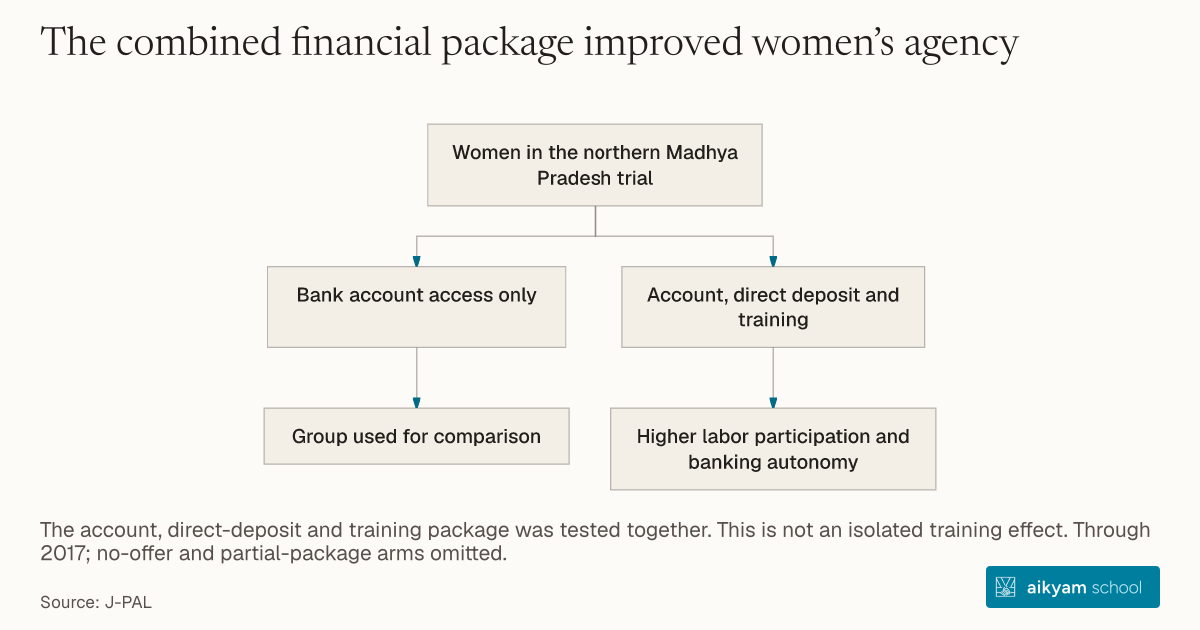
Women in the northern Madhya Pradesh trial
- Bank account access only
- Group used for comparison
- Account, direct deposit and training
- Higher labor participation and banking autonomy
The account, direct-deposit and training package was tested together. This is not an isolated training effect. Through 2017; no-offer and partial-package arms omitted.
See source →Research question
When women in rural India receive bank accounts without practical instruction, lack of technical knowledge and confidence prevents independent operation of village banking kiosks.
Participants
N = 5,851 women in 197 gram panchayats (village clusters) across Gwalior, Morena, Shivpuri, and Sheopur districts in Madhya Pradesh, India.
Study Design
Four-arm Randomized Controlled Trial (RCT) evaluating bank account provision alone versus account provision combined with direct wage deposits and kiosk training sessions across baseline (2013–2014), short-run (2015), and long-run (2017) surveys.
Results
Labor market participation and financial autonomy gains were concentrated exclusively among women who received both direct deposits and financial training, whereas bank account provision alone yielded negligible impact.
Takeaway
Couple bank account registration drives with structured, hands-on training sessions on operating village banking kiosks and executing financial transactions.
Source and citation
See source →Read alongside the research
Plain-English glossary
Original explanations, informed by the references below. Examples are illustrations, not data from the studies above. The research text stays unchanged.
- Baseline
The starting measurements in a study. Researchers use these to compare what participants were like at the start with what happens later.
ExampleBefore a training programme starts, researchers measure workers’ earnings. That first measurement is the baseline.
GET-IT glossary · Baseline characteristics ↗Read more about baseline →- Randomized controlled trial
A study that uses chance, like drawing lots, to decide who receives each option being compared. Researchers compare the groups’ outcomes to estimate the effect of those options.
ExampleA lottery assigns volunteers to a training programme or a comparison group. Researchers then compare their outcomes.
GET-IT glossary · Randomized study ↗Read more about randomized controlled trial →