In Simple Words
Imagine a sports league where female players are never selected to coach due to traditional prejudice rather than capability. Intentionally appointing qualified female workers into supervisor positions demonstrates their managerial effectiveness to both male and female subordinates, eroding gender stereotypes without causing any decline in team output.
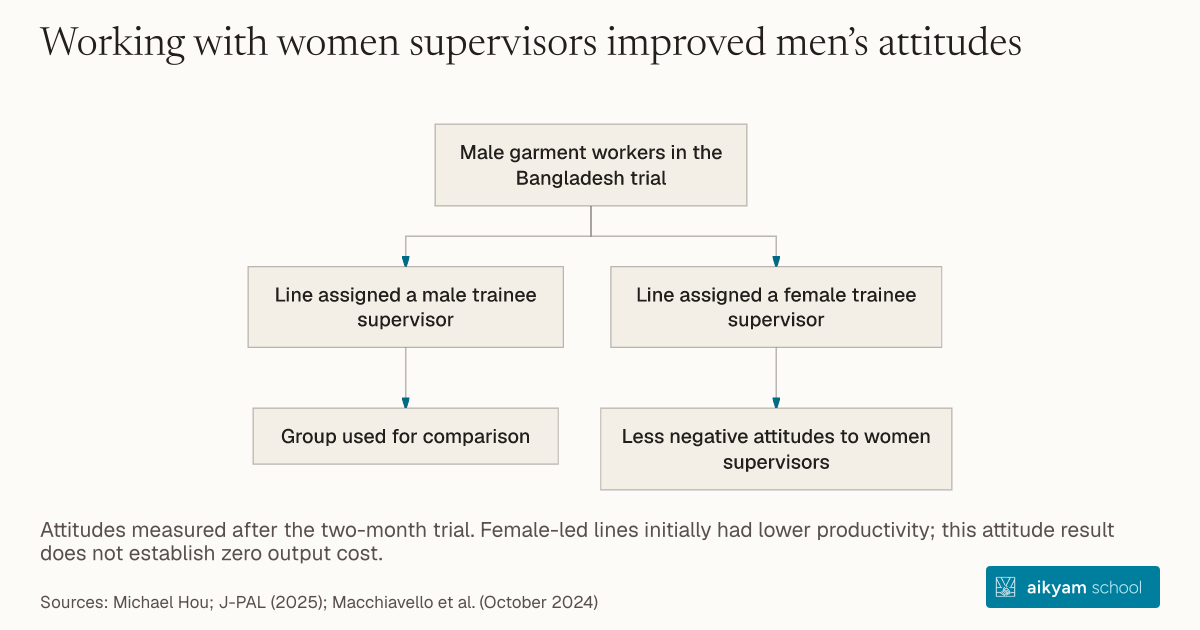
Male garment workers in the Bangladesh trial
- Line assigned a male trainee supervisor
- Group used for comparison
- Line assigned a female trainee supervisor
- Less negative attitudes to women supervisors
Attitudes measured after the two-month trial. Female-led lines initially had lower productivity; this attitude result does not establish zero output cost.
See source →Promotion trial — Macchiavello and colleagues ↗Research question
Deeply entrenched gender biases and systemic barriers routinely prevent qualified female production line workers from advancing into management roles. This underutilization of female talent reinforces workplace discrimination and restricts leadership diversity in industrial settings.
Participants
Female garment manufacturing workers in Bangladeshi export factories.
Study Design
Randomized Controlled Trial evaluating deliberate promotion of qualified female line workers to supervisory positions compared to traditional supervisory selection practices.
Results
Deliberately promoting women to line supervisor roles successfully challenged and reduced discriminatory gender beliefs among factory staff while maintaining full operational line productivity with zero performance loss.
Takeaway
Establish transparent, merit-based promotion pathways specifically designed to advance qualified female frontline workers into supervisory roles.
Source and citation
See source →Read alongside the research
Plain-English glossary
Original explanations, informed by the references below. Examples are illustrations, not data from the studies above. The research text stays unchanged.
- Randomized controlled trial
A study that uses chance, like drawing lots, to decide who receives each option being compared. Researchers compare the groups’ outcomes to estimate the effect of those options.
ExampleA lottery assigns volunteers to a training programme or a comparison group. Researchers then compare their outcomes.
GET-IT glossary · Randomized study ↗Read more about randomized controlled trial →