Research procedure
Observe tasks and share performance
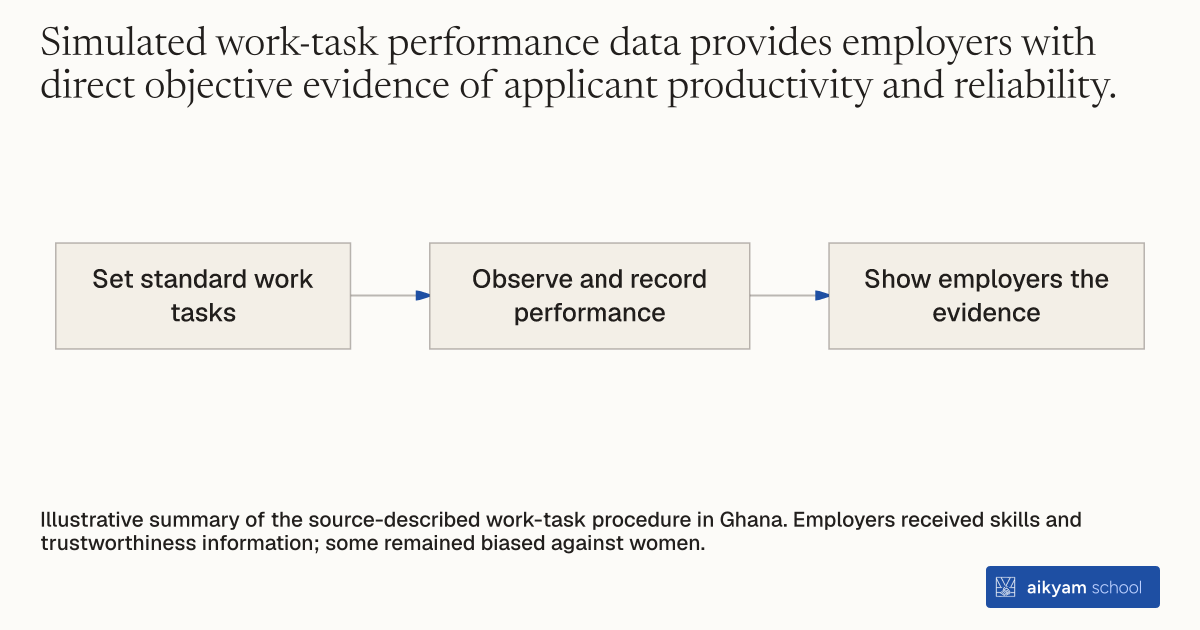
- Set standard work tasks
- Observe and record performance
- Show employers the evidence
Illustrative summary of the source-described work-task procedure in Ghana. Employers received skills and trustworthiness information; some remained biased against women.
See source →How
When to use
Employers harbor biased beliefs regarding worker skills and trustworthiness, particularly toward marginalized job seekers such as female candidates. Standard credentials may fail to alter deeply rooted hiring prejudices without direct behavioral observation. This method uses simulated work tasks to measure employer belief updating and hiring responses.
Administer standardized simulated work-task games to job candidates to test skills and present behavioral performance data to prospective employers.
- Evaluators set up standardized simulated work tasks that mimic actual job duties.
- Job applicants perform the simulated tasks under controlled observational conditions.
- Evaluators record objective performance, productivity, and trustworthiness metrics during task execution.
- Program directors present detailed task performance data to prospective hiring employers during candidate screening.
Why it works
While detailed skill signals shift beliefs for many employers, deeply entrenched biases can persist despite clear performance information.
Example
In Ghana, researchers evaluated a simulated work-task intervention where hiring employers received detailed information about job seekers' skills and trustworthiness observed during task performance. Despite receiving verified performance signals, some employers remained biased against female candidates.
About the study
Participants
Human hiring employers and job seekers in Ghana.
Study Design
Randomized evaluation using simulated work-task games to test employer belief updating and hiring responses to candidate skill signals.
Results
Providing detailed performance information from simulated work tasks shifted beliefs for many employers, but some hiring employers remained biased against female candidates despite objective proof of their trustworthiness and skills.