In Simple Words
Think of investing in a software tool that costs $50 to speed up an employee's work so well that it saves $60 in payroll costs, compared to paying an outside contractor $300 for the same task without saving any payroll time at all.
Job seekers at risk of long unemployment
- Standard public counseling
- Group used for comparison
- Private intensive counseling
- Net expenses about €1,162 higher per enrollee
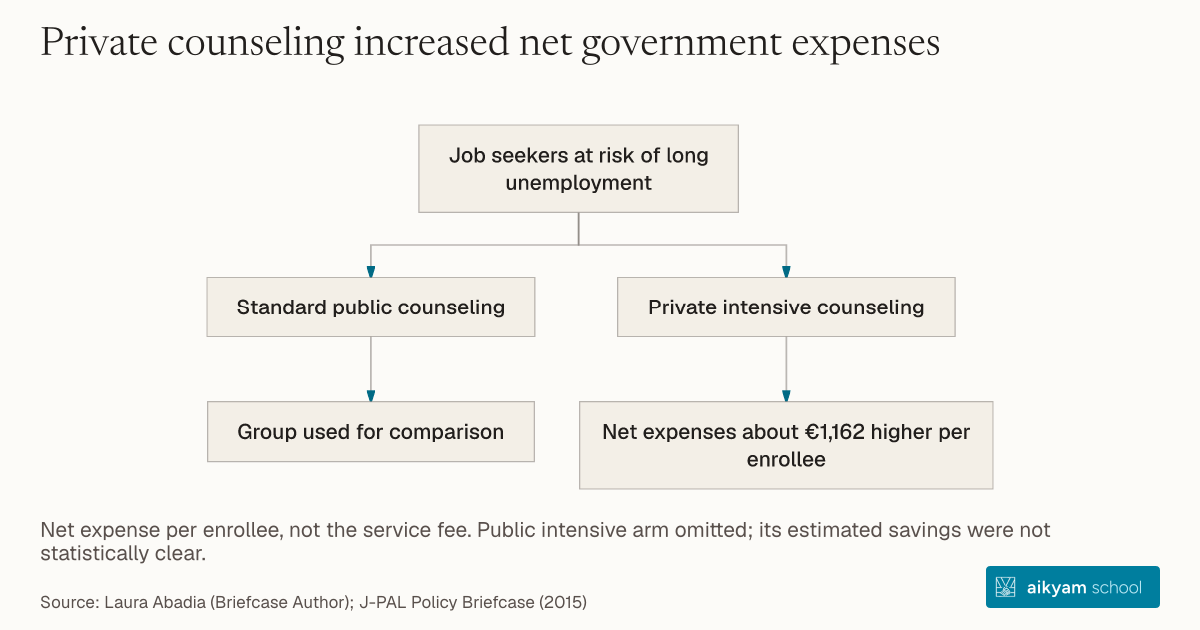
Private intensive counseling raised net government expenses by about €1,162 per enrolled job seeker compared with standard counseling. Public intensive savings were uncertain. Net expense per enrollee, not the service fee. Public intensive arm omitted; its estimated savings were not statistically clear.
See source →Research question
Active Labor Market Policies (ALMPs) are designed to offset upfront administration costs by accelerating exits from unemployment and reducing total government outlays on unemployment benefits. High per-client costs in outsourced welfare programs can undermine net fiscal savings if placement speed gains do not significantly reduce benefit duration.
Participants
Nearly 44,000 job seekers across 216 public employment offices in four French administrative regions.
Study Design
RCT measuring baseline program expenditures against total administrative cost savings and unemployment benefit payout durations over 12 months.
Results
Standard public counseling cost €120 per client. Public intensive counseling cost €657 per client and reduced government net costs slightly per job seeker (statistically non-significant). Private intensive counseling cost between €900 and €3,947 per client and increased total net government expenses by approximately €1,162 per enrollee without reducing overall unemployment benefit days paid.
Takeaway
Require cost-effectiveness calculations for outsourced public programs to factor in net benefit payout savings alongside administrative service fees.
Source and citation
See source →Read alongside the research
Plain-English glossary
Original explanations, informed by the references below. Examples are illustrations, not data from the studies above. The research text stays unchanged.
- Randomized controlled trial
A study that uses chance, like drawing lots, to decide who receives each option being compared. Researchers compare the groups’ outcomes to estimate the effect of those options.
ExampleA lottery assigns volunteers to a training programme or a comparison group. Researchers then compare their outcomes.
GET-IT glossary · Randomized study ↗Read more about randomized controlled trial →