In Simple Words
Relational mentoring functions like a copilot offering personalized route corrections during a journey; female drivers readily establish trust with the copilot and alter their route accordingly, whereas male drivers engage in conversation with the copilot but resist internalizing the advice to change their navigation habits.
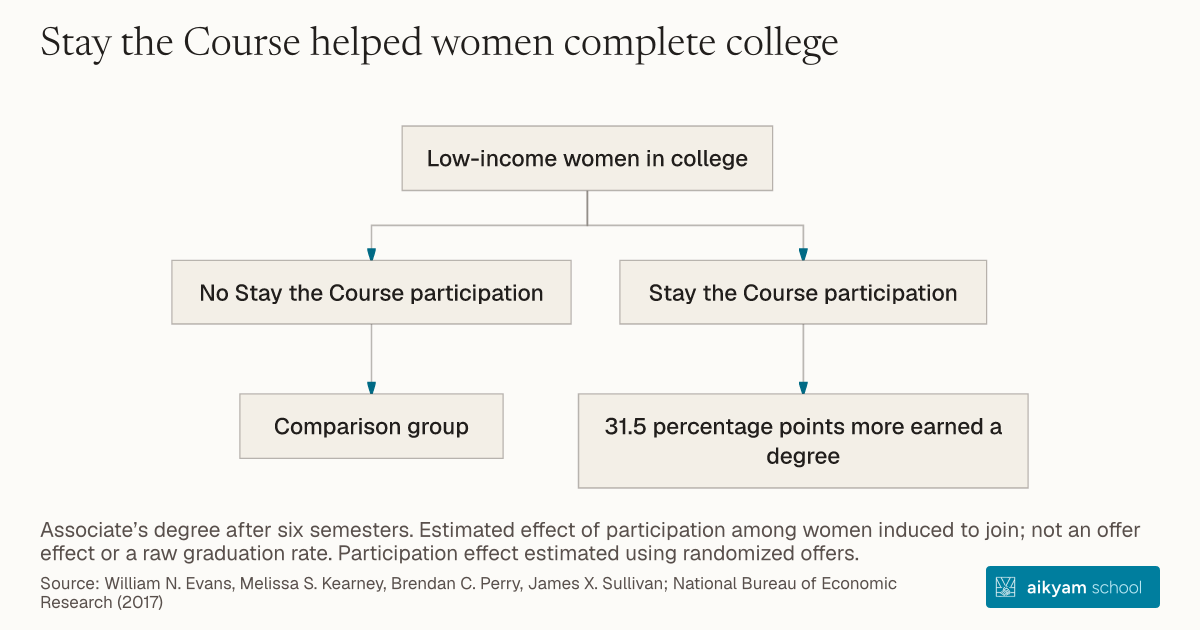
Low-income women in college
- No Stay the Course participation
- Comparison group
- Stay the Course participation
- 31.5 percentage points more earned a degree
Associate’s degree after six semesters. Estimated effect of participation among women induced to join; not an offer effect or a raw graduation rate. Participation effect estimated using randomized offers.
See source →Research question
Comprehensive case management and relational mentoring interventions produce markedly uneven academic returns across male and female students in higher education. Female community college students show massive gains in college persistence and graduation, whereas male students demonstrate no statistically significant improvements.
Participants
Subsample of N = 569 female students and N = 300 male students from the main RCT trial sample at Tarrant County College in Fort Worth, Texas.
Study Design
Randomized Controlled Trial (RCT) evaluated using OLS Intent-to-Treat (ITT) and 2SLS Instrumental Variable Treatment-on-the-Treated (TOT) models.
Results
Treatment-on-the-Treated (TOT) associate degree completion for female participants tripled (31.5 percentage point increase, p < 0.05) off a 15.7% control group mean, while male outcomes showed no significant impact (ITT = -0.025, standard error = 0.040). Standalone Action: Pair male postsecondary students with gender-matched mentors and structure coaching frameworks to specifically address gender-based differences in advising receptivity.
Source and citation
See source →Read alongside the research
Plain-English glossary
Original explanations, informed by the references below. Examples are illustrations, not data from the studies above. The research text stays unchanged.
- Percentage points
The difference between two percentages.
ExampleA rise from 40% to 50% is 10 percentage points. Relative to the starting value, that is a 25% increase.
Office for National Statistics · Percentages ↗Read more about percentage points →- Randomized controlled trial
A study that uses chance, like drawing lots, to decide who receives each option being compared. Researchers compare the groups’ outcomes to estimate the effect of those options.
ExampleA lottery assigns volunteers to a training programme or a comparison group. Researchers then compare their outcomes.
GET-IT glossary · Randomized study ↗Read more about randomized controlled trial →- Statistically significant
A label used when a result passes a chosen statistical threshold, often p < 0.05. It does not show how large or useful an effect is. A result that is not statistically significant does not prove there is no effect.
ExampleA study reports p = 0.03 against a 0.05 threshold. It passes that test, but the effect could still be too small to matter.
American Statistical Association · Statement on p-values ↗Read more about statistically significant →