In Simple Words
Instead of explaining a financial tool on a chalkboard to a full room, an expert sits down one-on-one with a business owner to apply the formulas directly to the owner's actual sales receipts and expense logs. This turns abstract accounting concepts into customized, repeatable daily habits.
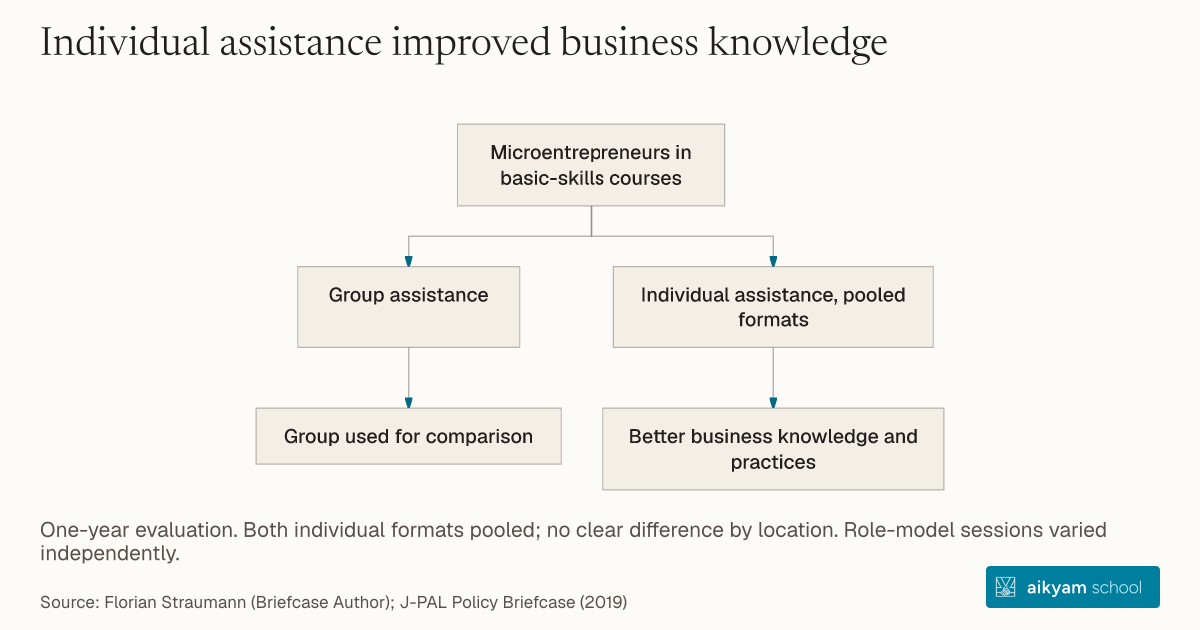
Microentrepreneurs in basic-skills courses
- Group assistance
- Group used for comparison
- Individual assistance, pooled formats
- Better business knowledge and practices
Individualized assistance improved final exam performance, business analysis and revenue calculation versus group assistance. Source reports no difference between individual-assistance locations. One-year evaluation. Both individual formats pooled; no clear difference by location. Role-model sessions varied independently.
See source →Research question
Microentrepreneurs often fail to improve firm productivity due to persistent gaps in foundational administrative capabilities, such as improper revenue calculation and lack of formal business analysis. Generalized classroom instruction alone is frequently insufficient to help business owners operationalize complex analytical frameworks in their unique daily operations.
Participants
N = 1,347 microentrepreneurs across 53 basic skills training courses in Chile (92% female, lowest two income quartiles).
Study Design
Randomized evaluation comparing individual consulting at the business location, individual consulting before/after class, and group consulting comparison groups.
Results
Generated a US$30–US$50 (~15%) increase in monthly household income after 1 year, alongside statistically significant improvements in final exam scores, revenue calculation accuracy, and business analyses conducted.
Takeaway
Schedule one-on-one technical consulting sessions with microentrepreneurs before or after class to walk through customized break-even point and SWOT analyses using actual firm financial data.
Source and citation
See source →Read alongside the research
Plain-English glossary
Original explanations, informed by the references below. Examples are illustrations, not data from the studies above. The research text stays unchanged.
- Statistically significant
A label used when a result passes a chosen statistical threshold, often p < 0.05. It does not show how large or useful an effect is. A result that is not statistically significant does not prove there is no effect.
ExampleA study reports p = 0.03 against a 0.05 threshold. It passes that test, but the effect could still be too small to matter.
American Statistical Association · Statement on p-values ↗Read more about statistically significant →