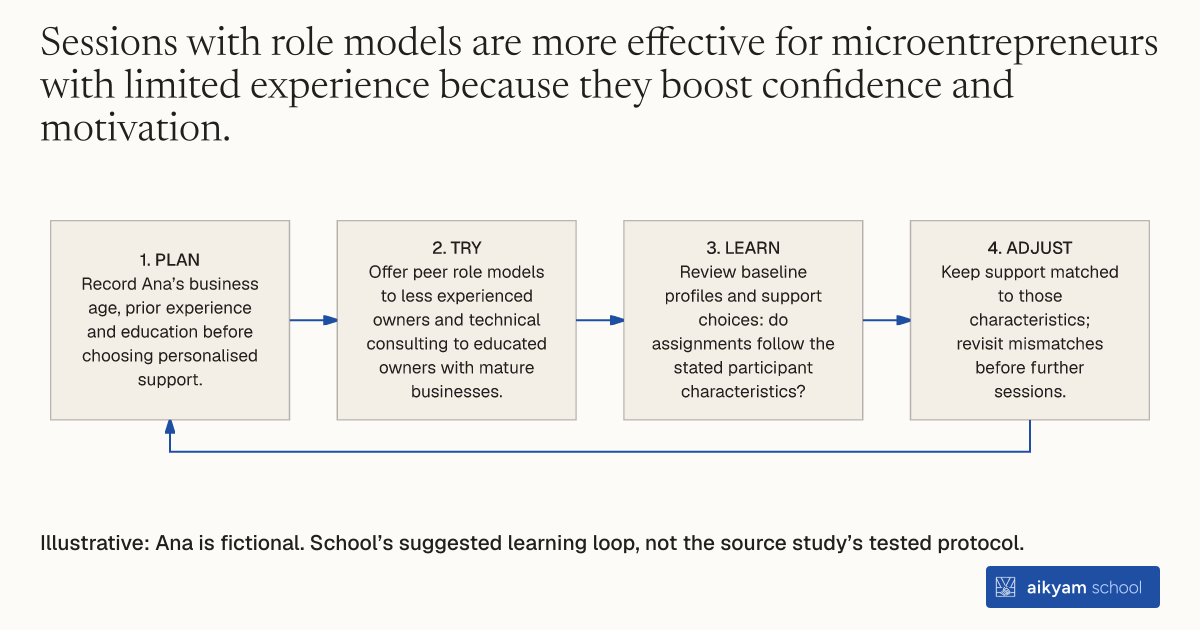
Try, learn and adjust
Check support matches experience and education
- Plan: Record Ana’s business age, prior experience and education before choosing personalised support.
- Try: Offer peer role models to less experienced owners and technical consulting to educated owners with mature businesses.
- Learn: Review baseline profiles and support choices: do assignments follow the stated participant characteristics?
- Adjust: Keep support matched to those characteristics; revisit mismatches before further sessions.
Illustrative: Ana is fictional. School’s suggested learning loop, not the source study’s tested protocol.
See source →School’s suggested loop, not a tested source procedure. Observe participant profiles and support choices; subgroup patterns do not guarantee individual income gains.
How
When to use
Microenterprise training programs often yield variable results when identical components are delivered across diverse cohorts. Novice business owners and experienced, highly educated entrepreneurs face distinct barriers that require different forms of personalization. This method targets microentrepreneurs by segmenting participants according to business age, prior experience, and formal education levels.
Segment microenterprise training participants based on prior business experience and formal education to deliver targeted personalized support.
- Screen incoming course applicants to collect baseline data on business age, operating experience, and formal education completed.
- Direct microentrepreneurs with younger businesses and limited experience into peer role model classroom sessions.
- Direct microentrepreneurs with higher formal education degrees and mature businesses into individual technical consulting sessions.
- Avoid delivering high-cost individual consulting to inexperienced entrepreneurs who benefit more from motivation and self-efficacy building.
- Allocate program resources efficiently by aligning technical assistance costs with participants who gain the largest administrative improvements.
Why it works
Individual technical assistance is more useful for individuals with higher education and established microenterprises because it enhances administrative practices and analytical knowledge.
Example
Researchers evaluated participant heterogeneity across 66 training courses delivered by Simón de Cirene in Chile to 1,712 low-income microentrepreneurs, 92 percent of whom were women. They found that peer role model sessions delivered larger income gains for participants with younger businesses and less experience, whereas individualized technical assistance delivered greater benefits for participants with higher educational levels and more mature businesses.
About the study
Participants
1,712 participants in 66 training courses across Chile, 92 percent female, with 50 percent high school graduates and 30 percent holding technical or university education.
Study Design
A two-stage randomized evaluation analyzing heterogeneous treatment effects across subgroup characteristics including business age, owner experience, and formal education level.
Results
Both personalized interventions increased monthly household income by US\$30 to US\$50 (about 15 percent above the US\$228 comparison group average), but role models impacted less experienced owners more, while individual assistance impacted highly educated, established business owners more.