Try, learn and adjust
Check comparison-group support stays in its assigned format
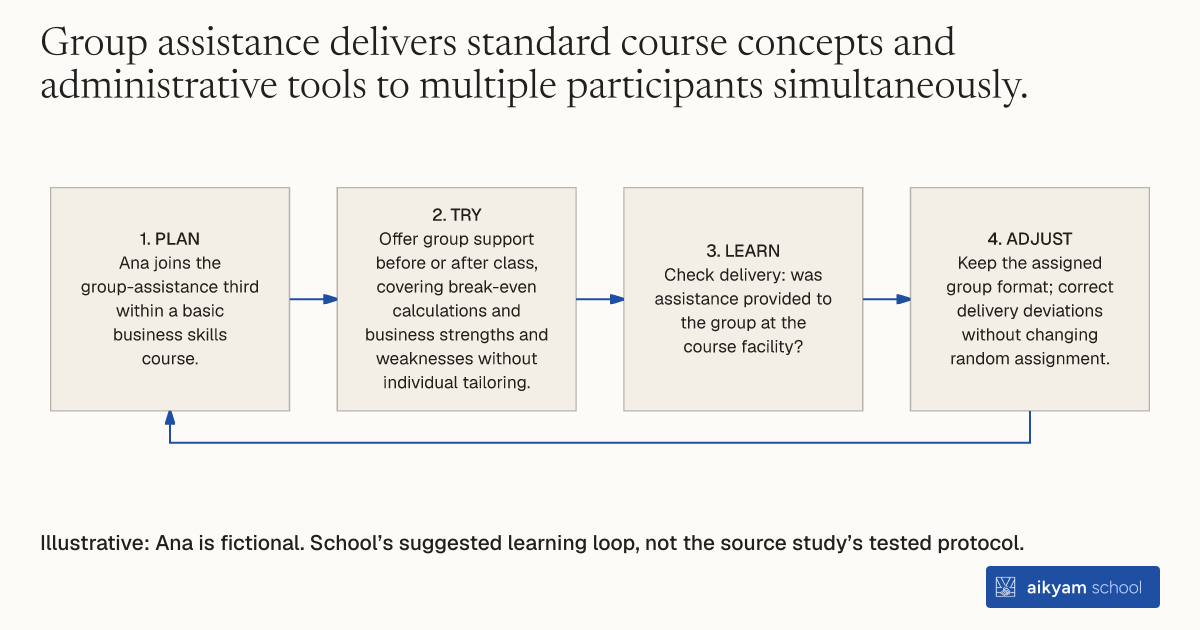
- Plan: Ana joins the group-assistance third within a basic business skills course.
- Try: Offer group support before or after class, covering break-even calculations and business strengths and weaknesses without individual tailoring.
- Learn: Check delivery: was assistance provided to the group at the course facility?
- Adjust: Keep the assigned group format; correct delivery deviations without changing random assignment.
Illustrative: Ana is fictional. School’s suggested learning loop, not the source study’s tested protocol.
See source →School’s suggested loop, not a tested source procedure. Observe group format, timing and content. The comparison group remains distinct from both individual-assistance groups.
How
When to use
Microenterprise training programs require control or comparison formats to benchmark the added impact of individualized consulting. Delivering non-individualized technical assistance in a group setting before or after class provides standard group instruction at low delivery friction. This approach serves informal microentrepreneurs attending basic skills business courses who participate in group-based learning.
Deliver group-based technical assistance before or after scheduled business training classes to serve as a comparison format for individualized coaching.
- Form group cohorts of microentrepreneurs enrolled in basic skills training courses.
- Schedule technical assistance sessions immediately before or after regular class hours at the course facility.
- Convene participants in group settings rather than one-on-one consulting arrangements.
- Review core business strategies, including break-even point analysis and SWOT analysis, across the group.
- Provide standard administrative guidance without individual firm-level tailoring.
Why it works
However, because it lacks individual firm tailoring, it yields lower household income gains than individualized consulting or peer role model visits.
Example
In Chile, Simón de Cirene provided group-based technical assistance before or after class to 449 microentrepreneurs across 53 basic skills courses as a comparison group. One year after program start, participants receiving group assistance achieved an average monthly household income of US\$228, compared to US\$259 and US\$265 for those receiving individualized technical assistance.
About the study
Participants
1,347 microentrepreneurs across 53 basic skills courses in Chile, 92 percent female, with all participants belonging to the lowest two income quartiles.
Study Design
Within 53 basic skills courses, participants were randomly assigned in equal thirds to individualized assistance at their business, individualized assistance before or after class, or group assistance before or after class serving as the comparison group.
Results
Group assistance resulted in an average monthly household income of US\$228 one year post-program, whereas individualized assistance increased household income to US\$259–US\$265 (about 15 percent higher).