In Simple Words
Handing a prospective employer a written letter of recommendation is redundant when a trusted friend or colleague introduces the applicant directly. The direct word-of-mouth referral replaces the paper document, making the physical reference letter unnecessary during the hiring process.
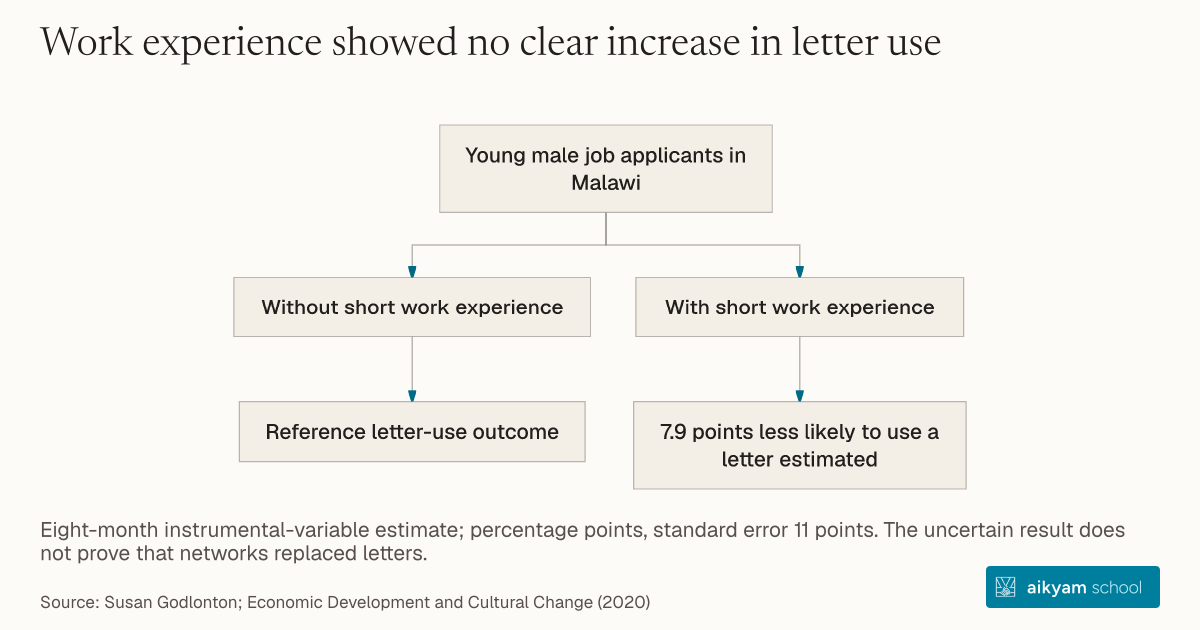
Young male job applicants in Malawi
- Without short work experience
- Reference letter-use outcome
- With short work experience
- 7.9 points less likely to use a letter estimated
Eight-month instrumental-variable estimate; percentage points, standard error 11 points. The uncertain result does not prove that networks replaced letters.
See source →Research question
Formal reference letters from prior employers are widely assumed to reduce screening friction for job seekers. However, in urban male labor markets dominated by informal networks, written recommendations may be redundant or underutilized when personal social connections mediate job placements.
Participants
N = 227 urban Malawian male job seekers tracked over an 8-month follow-up period in Lilongwe, Malawi.
Study Design
Instrumental variables (IV) regression assessing the causal effect of acquiring short-term work experience and a standard employer reference letter on subsequent reference letter utilization during job applications.
Results
Participants acquiring work experience and a reference letter were 7.9 percentage points less likely to submit a reference letter when applying for jobs (IV coefficient = -0.079, standard error = 0.110) and reduced the total number of times a reference letter was submitted by 0.381 times.
Takeaway
Combine reference letter distribution programs with active workplace networking opportunities to maximize candidate signaling and job placement channels.
Source and citation
See source →Read alongside the research
Plain-English glossary
Original explanations, informed by the references below. Examples are illustrations, not data from the studies above. The research text stays unchanged.
- Follow-up
Collecting more information about participants later in a study to see what has happened to them. The term can also mean the length of time researchers keep track of them.
ExampleResearchers interview the same workers three months after a programme ends. That later interview is a follow-up.
GET-IT glossary · Follow-up ↗Read more about follow-up →- Percentage points
The difference between two percentages.
ExampleA rise from 40% to 50% is 10 percentage points. Relative to the starting value, that is a 25% increase.
Office for National Statistics · Percentages ↗Read more about percentage points →