In Simple Words
Think of a family household as a tandem bicycle where only one person wants to steer toward a new destination. If that rider keeps quiet, the bicycle stays on the routine path. A structured goal-setting session acts as a roadmap exercise: the rider defines a specific 6-month stop, breaks down the pedaling steps on paper, and sits down with the partner to discuss the route, getting both riders to pedal toward the same destination.
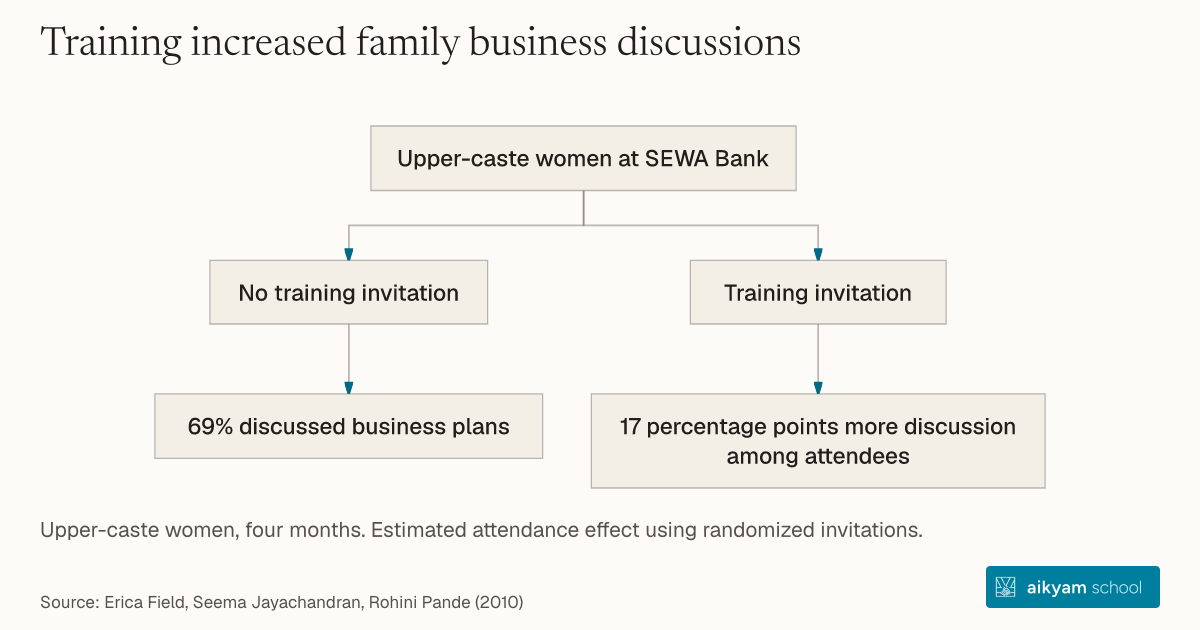
Upper-caste women at SEWA Bank
- No training invitation
- 69% discussed business plans
- Training invitation
- 17 percentage points more discussion among attendees
Four-month business-plan discussions with family. Randomized invitations identify an attendance effect; other social-group interactions are not shown.
See source →Research question
Female micro-entrepreneurs in traditional settings often operate without clear long-term growth strategies or domestic support for business expansion. Without structured goal alignment, intra-household financial friction and limited agency prevent female business owners from investing in high-return business opportunities.
Participants
N = 597 female micro-entrepreneurs affiliated with SEWA Bank in Ahmedabad, India, with 289 women receiving the 2-day training treatment.
Study Design
RCT evaluating a 2-day business curriculum that incorporated a motivational film of successful peers, a 6-month business goal worksheet homework, and actionable short-run planning steps.
Results
Attending the training increased the proportion of upper-caste Hindu women who discussed business plans with family members by 17 percentage points (p < 0.05; baseline mean = 0.69). The differential treatment effect on business dialogue was -0.51 percentage points (p < 0.001) for Scheduled Caste women and -0.35 percentage points (p < 0.001) for Muslim women.
Takeaway
Incorporate mandatory short-term goal decomposition worksheets and explicit intra-household communication exercises into female financial literacy programs to build household consensus for business expansion.
Source and citation
See source →Read alongside the research
Plain-English glossary
Original explanations, informed by the references below. Examples are illustrations, not data from the studies above. The research text stays unchanged.
- Percentage points
The difference between two percentages.
ExampleA rise from 40% to 50% is 10 percentage points. Relative to the starting value, that is a 25% increase.
Office for National Statistics · Percentages ↗Read more about percentage points →- Randomized controlled trial
A study that uses chance, like drawing lots, to decide who receives each option being compared. Researchers compare the groups’ outcomes to estimate the effect of those options.
ExampleA lottery assigns volunteers to a training programme or a comparison group. Researchers then compare their outcomes.
GET-IT glossary · Randomized study ↗Read more about randomized controlled trial →