In Simple Words
Think of a host country as a gated office building that refuses to give temporary security badges to visiting workers, keeping them stuck in the waiting room. A compact acts as a bilateral trade agreement: foreign partners unlock special export deals and financial loans for the building owner in exchange for granting security badges (work permits) to the visitors, allowing them to legally enter offices, earn wages, and contribute to the building's maintenance.
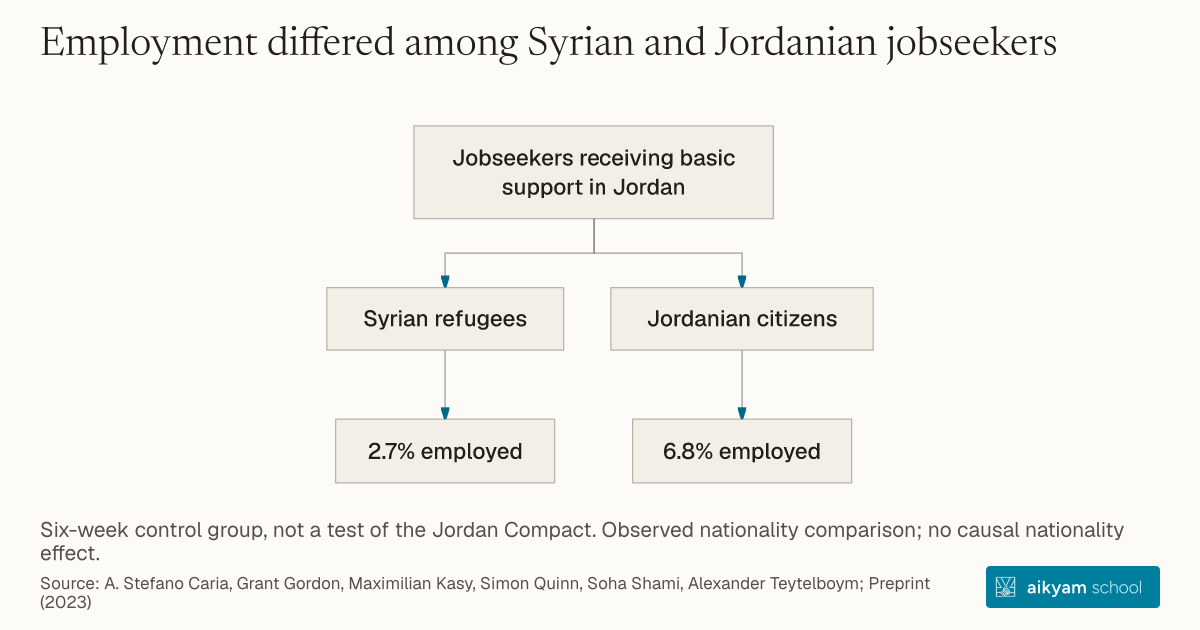
Jobseekers receiving basic support in Jordan
- Syrian refugees
- 2.7% employed
- Jordanian citizens
- 6.8% employed
Six-week control group, not a test of the Jordan Compact. Observed nationality comparison; no causal nationality effect.
See source →Research question
Refugees in host nations are frequently restricted to humanitarian camp aid and barred from legal labor markets, leading to severe economic dependency and systemic poverty. Host countries face high administrative and fiscal burdens when integrating large displaced populations without foreign investment or trade incentives.
Participants
Syrian refugees (~660,000 registered in Jordan, ~1.3 million overall) and local Jordanian jobseekers in Amman, Irbid, and Mafraq.
Study Design
Policy framework analysis combined with field survey evaluations tracking labor market access following bilateral trade and loan commitments ($2.1B in direct grants, $1.9B in loans).
Results
Pledged 200,000 work permits for Syrian refugees in agriculture, construction, and manufacturing by relaxing administrative barriers and trade rules of origin. However, 93% of urban refugees initially remained below the national poverty line ($5/day), and control group employment rates remained low at 2.7% for Syrians and 6.8% for Jordanians.
Takeaway
Negotiate international compacts that combine trade concessions and concessional financing for host nations with formal commitments to grant work permits and reduce regulatory labor barriers for displaced populations.