In Simple Words
Imagine a library that requires visitors to physically check a bulletin board every morning to see if new books have arrived versus sending an automated text message directly to their phones the minute a desired book is returned.
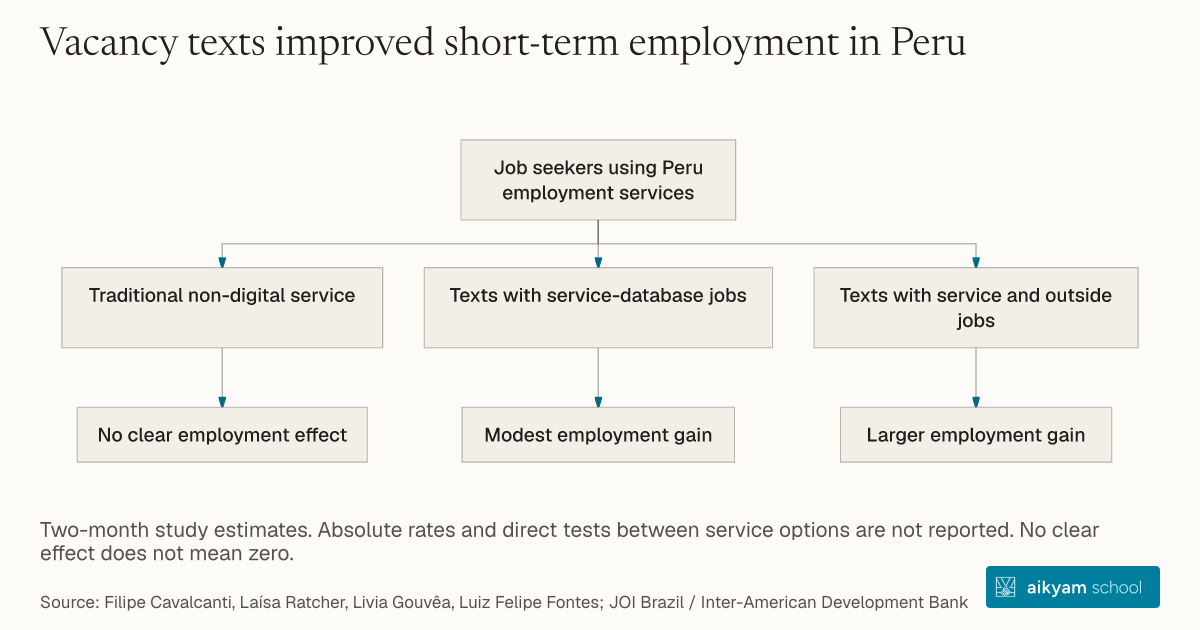
Job seekers using Peru employment services
- Traditional non-digital service
- No clear employment effect
- Texts with service-database jobs
- Modest employment gain
- Texts with service and outside jobs
- Larger employment gain
The Peru experiment evaluated texts containing vacancies from the service database and texts including outside vacancies. The review reports modest two-month employment gains with SMS, no detectable effect of traditional intermediation, and larger employability effects for the outside-vacancy group. These are reported study estimates, not absolute employment rates or a claim of a significant direct difference between SMS arms.
See source →Research question
Traditional Public Employment Services rely heavily on physical office visits or passive online portals, creating search costs and information delays for job seekers who lack regular internet access or transportation.
Participants
Job seekers registered with Peru's Public Employment Service (PES).
Study Design
Multi-treatment randomized controlled trial comparing traditional in-person PES services against automated SMS vacancy alerts drawing from internal PES databases and external job postings.
Results
Delivering job vacancy information via SMS generated modest positive impacts on short-term (2-month) employment, whereas traditional non-digital intermediation produced no statistically detectable effect. Sending SMS alerts containing vacancies from both inside and outside the PES database yielded the largest gains in employability and online search activity at minimal additional cost.
Takeaway
Integrate automated SMS job vacancy alerts into public employment service workflows to push relevant openings directly to job seekers' mobile devices.
Source and citation
See source →Evidence in Labor Market Policies and Implications for Brazil: Job Search Assistance
Copyright © 2023 Inter-American Development Bank.
Full source notice
Copyright © 2023 Inter-American Development Bank ("IDB"). This work is subject to a Creative Commons license CC BY 3.0 IGO (https://creativecommons.org/licenses/by/3.0/igo/legalcode). The terms and conditions indicated in the URL link must be met and the respective recognition must be granted to the IDB. Further to section 8 of the above license, any mediation relating to disputes arising under such license shall be conducted in accordance with the WIPO Mediation Rules. Any dispute related to the use of the works of the IDB that cannot be settled amicably shall be submitted to arbitration pursuant to the United Nations Commission on International Trade Law (UNCITRAL) rules. The use of the IDB's name for any purpose other than for attribution, and the use of IDB's logo shall be subject to a separate written license agreement between the IDB and the user and is not authorized as part of this license. Note that the URL link includes terms and conditions that are an integral part of this license.
Read alongside the research
Plain-English glossary
Original explanations, informed by the references below. Examples are illustrations, not data from the studies above. The research text stays unchanged.
- Randomized controlled trial
A study that uses chance, like drawing lots, to decide who receives each option being compared. Researchers compare the groups’ outcomes to estimate the effect of those options.
ExampleA lottery assigns volunteers to a training programme or a comparison group. Researchers then compare their outcomes.
GET-IT glossary · Randomized study ↗Read more about randomized controlled trial →