In Simple Words
Giving someone a textbook on driving does not help them get to work if they cannot afford a bus pass or a car. Combining the driving textbook with a dedicated savings account and matching funds gives the person both the knowledge and the financial resources required to actually purchase transportation and secure a job.
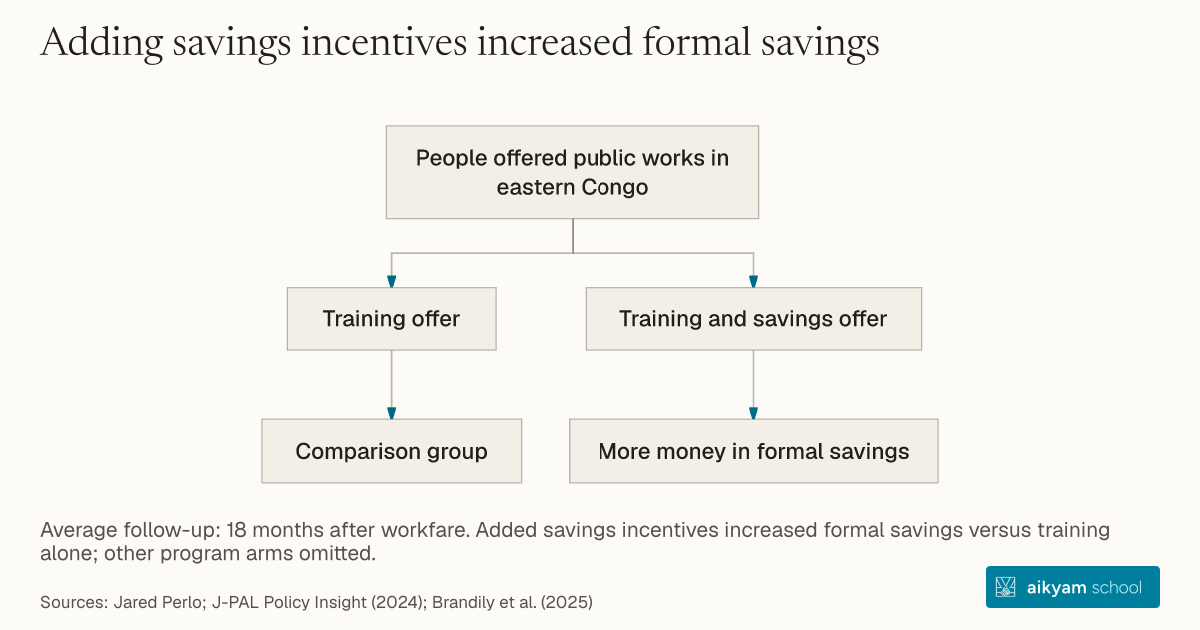
People offered public works in eastern Congo
- Training offer
- Comparison group
- Training and savings offer
- More money in formal savings
Average follow-up: 18 months after workfare. Added savings incentives increased formal savings versus training alone; other program arms omitted.
See source →Workfare trial design and results — Brandily et al. ↗Research question
Public works programs are often bundled with standalone vocational training under the assumption that teaching job skills will create lasting employment. However, skills training alone rarely translates into post-program employment or higher earnings in labor-constrained economies.
Participants
Low-income urban and rural participants in public works programs in the Democratic Republic of the Congo across 4 randomized evaluations measuring training impacts.
Study Design
Multi-arm randomized controlled trial comparing standalone workfare, workfare plus hard-skills training, and workfare plus hard-skills training combined with incentivized formal savings.
Results
Standalone skills training yielded no significant long-term impact on skills or employment; however, participants receiving hard-skills training bundled with an incentivized savings scheme experienced the largest positive impacts on job likelihood and total savings.
Takeaway
Bundle vocational skills training in public works programs with formal savings incentives rather than offering training as an isolated intervention.
Source and citation
See source →Read alongside the research
Plain-English glossary
Original explanations, informed by the references below. Examples are illustrations, not data from the studies above. The research text stays unchanged.
- Randomized controlled trial
A study that uses chance, like drawing lots, to decide who receives each option being compared. Researchers compare the groups’ outcomes to estimate the effect of those options.
ExampleA lottery assigns volunteers to a training programme or a comparison group. Researchers then compare their outcomes.
GET-IT glossary · Randomized study ↗Read more about randomized controlled trial →