In Simple Words
When a support initiative requires arriving early or staying late outside official class hours, students with job or family duties cannot participate even if the service is free. It is like opening a free community medical clinic that operates exclusively during standard business hours; the working citizens who need care cannot attend because leaving work forfeits their hourly income.
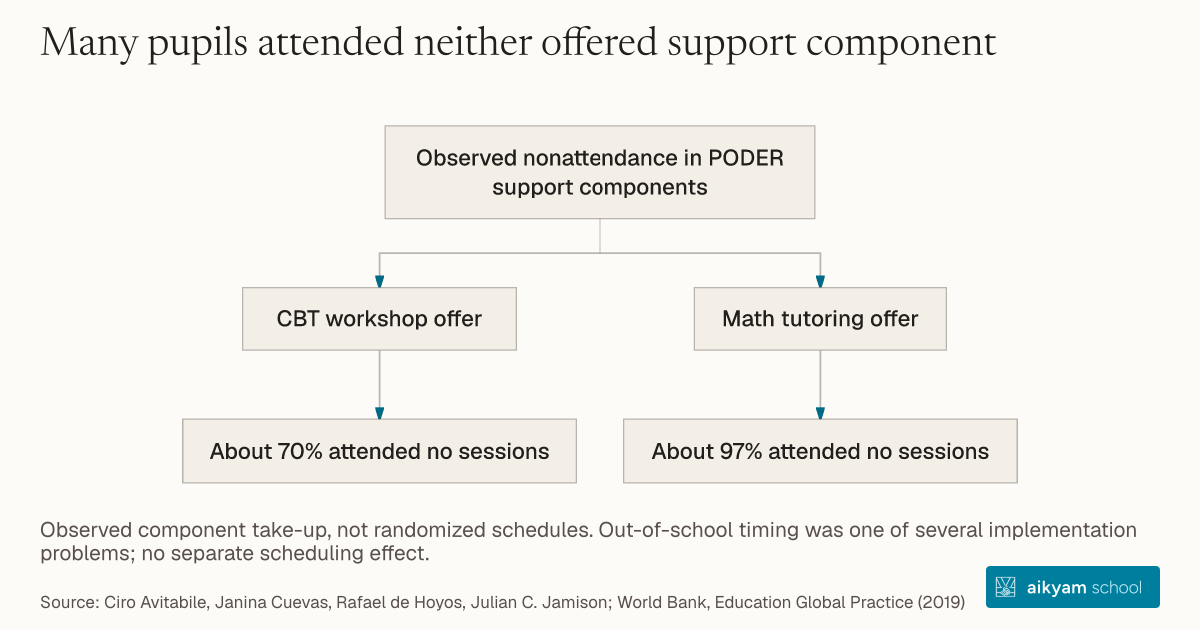
Observed nonattendance in PODER support components
- CBT workshop offer
- About 70% attended no sessions
- Math tutoring offer
- About 97% attended no sessions
Observed component take-up, not randomized schedules. Out-of-school timing was one of several implementation problems; no separate scheduling effect.
See source →Research question
Offering voluntary academic or socio-emotional support outside official school hours creates severe schedule friction and opportunity costs, particularly for working or evening-shift students.
Participants
N = 5,274 upper secondary students across 20 public high schools in Mexico City, where 35.1% of federal high school students hold jobs.
Study Design
Randomized field experiment combined with a qualitative process evaluation involving interviews and focus groups across 32 teachers and 216 students.
Results
Scheduling sessions outside normal class hours resulted in a 70.0% zero-attendance rate for cognitive behavioral therapy workshops and a 97.0% zero-attendance rate for supplementary mathematics tutoring.
Takeaway
Embed voluntary socio-emotional and academic support programs directly within compulsory school timetable hours to eliminate attendance friction for working students.