In Simple Words
Adding a brief period of new work experience onto prior research experience works like adding an advanced lens to a specialized camera. The new workplace exposure complements previously acquired technical data-collection skills, enabling the worker to command higher wages in skilled analytical job markets.
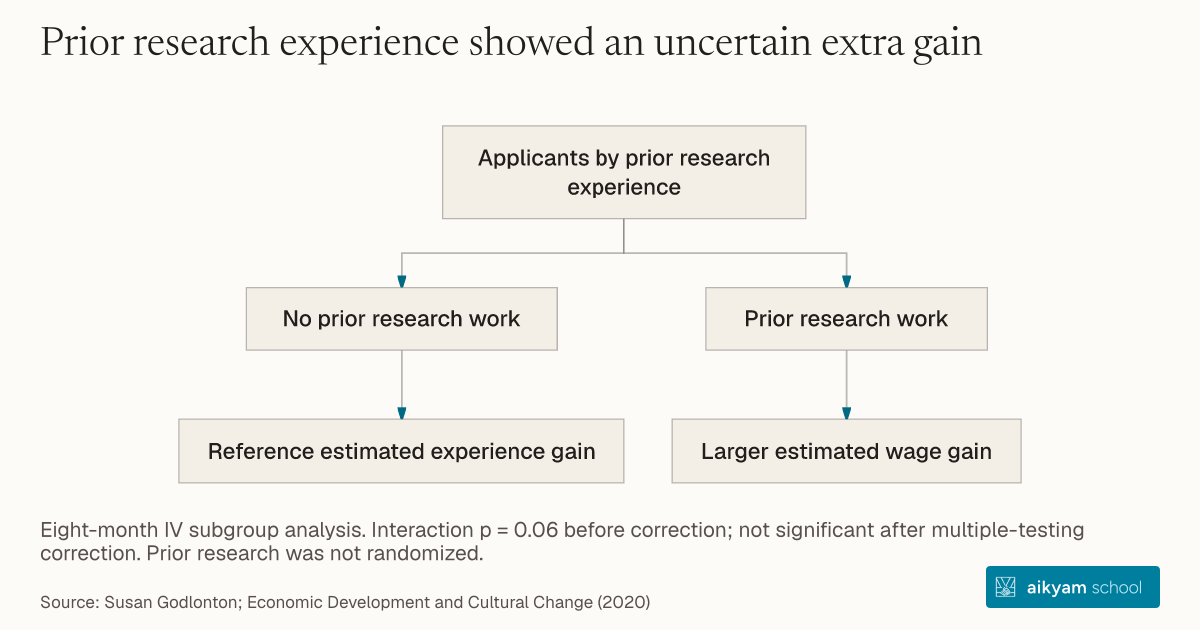
Applicants by prior research experience
- No prior research work
- Reference estimated experience gain
- Prior research work
- Larger estimated wage gain
Eight-month IV subgroup analysis. Interaction p = 0.06 before correction; not significant after multiple-testing correction. Prior research was not randomized.
See source →Research question
The economic payoff of acquiring additional short-term work experience varies depending on a worker's pre-existing baseline work exposure in specialized analytical domains such as field research.
Participants
N = 227 urban Malawian male job seekers tracked over an 8-month follow-up period in Lilongwe, Malawi.
Study Design
Instrumental variables (IV) estimation incorporating interaction terms between experimental job acquisition and baseline prior research experience.
Results
Acquiring short-term work experience yielded a statistically significant positive wage interaction for candidates with prior research experience (interaction coefficient = 1.079, standard error = 0.618, p = 0.06), demonstrating magnified wage gains for research-experienced individuals.
Takeaway
Target advanced workplace experience interventions toward individuals with existing specialized research backgrounds to compound technical wage premiums.
Source and citation
See source →Read alongside the research
Plain-English glossary
Original explanations, informed by the references below. Examples are illustrations, not data from the studies above. The research text stays unchanged.
- Follow-up
Collecting more information about participants later in a study to see what has happened to them. The term can also mean the length of time researchers keep track of them.
ExampleResearchers interview the same workers three months after a programme ends. That later interview is a follow-up.
GET-IT glossary · Follow-up ↗Read more about follow-up →- Baseline
The starting measurements in a study. Researchers use these to compare what participants were like at the start with what happens later.
ExampleBefore a training programme starts, researchers measure workers’ earnings. That first measurement is the baseline.
GET-IT glossary · Baseline characteristics ↗Read more about baseline →- Statistically significant
A label used when a result passes a chosen statistical threshold, often p < 0.05. It does not show how large or useful an effect is. A result that is not statistically significant does not prove there is no effect.
ExampleA study reports p = 0.03 against a 0.05 threshold. It passes that test, but the effect could still be too small to matter.
American Statistical Association · Statement on p-values ↗Read more about statistically significant →