In Simple Words
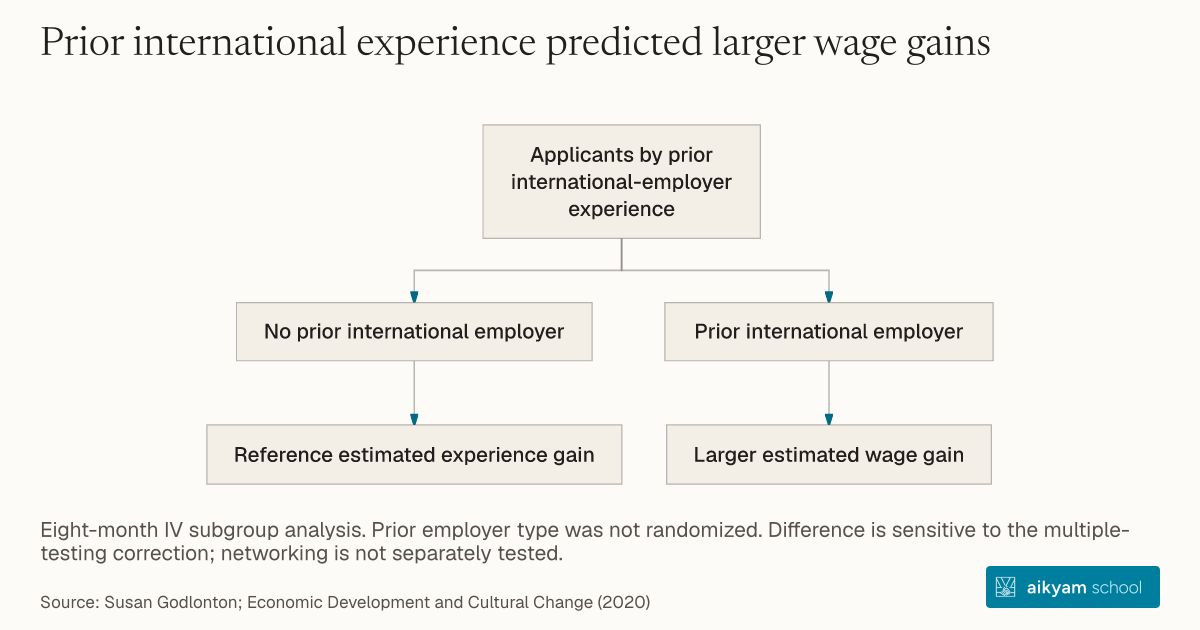
Having prior work experience with an international organization acts like a stamp of quality on a passport, reassuring future local employers that the candidate meets high organizational standards and deserves higher wage offers.
Applicants by prior international-employer experience
- No prior international employer
- Reference estimated experience gain
- Prior international employer
- Larger estimated wage gain
Eight-month IV subgroup analysis. Prior employer type was not randomized. Difference is sensitive to the multiple-testing correction; networking is not separately tested.
See source →Research question
The economic payoff of prior employment experience is often assumed to be uniform, ignoring how the institutional prestige and reputation of prior employers moderate signaling value in low-income labor markets.
Participants
N = 227 male job seekers re-interviewed at the 8-month follow-up in Lilongwe, Malawi.
Study Design
Heterogeneity analysis within an RCT/IV framework interacting baseline prior work experience with international employers against experimental job acquisition.
Results
The wage returns from acquiring short-term work experience were significantly magnified for candidates with prior international employer experience, yielding an interaction coefficient of 1.731 on inverse hyperbolic sine daily wages (p < 0.05).
Takeaway
Design youth employment placement programs in partnership with international employers or high-prestige organizations to maximize post-program wage premiums for participants.
Source and citation
See source →Read alongside the research
Plain-English glossary
Original explanations, informed by the references below. Examples are illustrations, not data from the studies above. The research text stays unchanged.
- Follow-up
Collecting more information about participants later in a study to see what has happened to them. The term can also mean the length of time researchers keep track of them.
ExampleResearchers interview the same workers three months after a programme ends. That later interview is a follow-up.
GET-IT glossary · Follow-up ↗Read more about follow-up →- Baseline
The starting measurements in a study. Researchers use these to compare what participants were like at the start with what happens later.
ExampleBefore a training programme starts, researchers measure workers’ earnings. That first measurement is the baseline.
GET-IT glossary · Baseline characteristics ↗Read more about baseline →- Randomized controlled trial
A study that uses chance, like drawing lots, to decide who receives each option being compared. Researchers compare the groups’ outcomes to estimate the effect of those options.
ExampleA lottery assigns volunteers to a training programme or a comparison group. Researchers then compare their outcomes.
GET-IT glossary · Randomized study ↗Read more about randomized controlled trial →