In Simple Words
Imagine a free municipal staffing agency that only attracts temporary, low-wage job listings because top employers post on private sites; candidates who get matched through the agency find work quickly, but end up earning less than they did in their previous career positions.
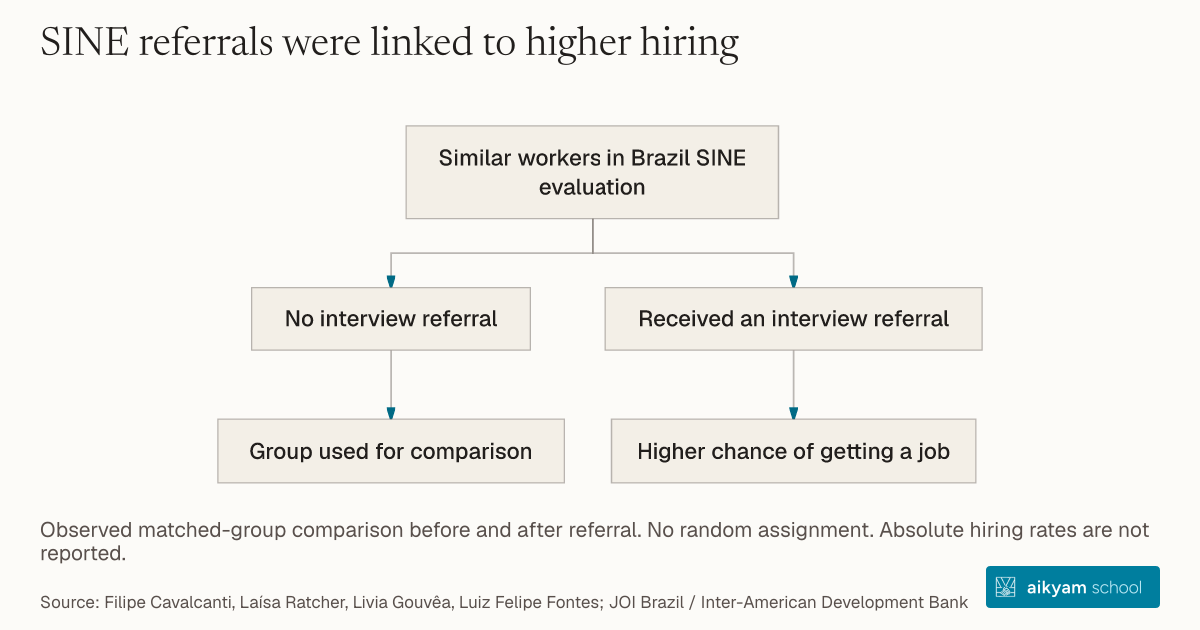
Similar workers in Brazil SINE evaluation
- No interview referral
- Group used for comparison
- Received an interview referral
- Higher chance of getting a job
The quasi-experimental SINE evaluation followed similar workers, with only one group receiving an interview referral, and compared the groups before and after referral. It reported increased job-finding chances. The source separately describes referred workers earning less than in their previous jobs; that is a different comparison and is not drawn here.
See source →Research question
Public employment services in developing economies often face declining usage among job seekers due to systemic difficulties in capturing high-quality job vacancies from private firms, leading to job placements that lower post-unemployment wages.
Participants
Job seekers in Brazil utilizing the National Employment System (SINE) between 2012 and 2022.
Study Design
Quasi-experimental evaluation utilizing administrative panel data and propensity score matching comparing job seekers who received SINE interview referrals against non-referred workers.
Results
National usage of SINE among Brazilian job seekers fell from 3.81% in 2012 to 1.81% in 2022. While receiving a job referral through SINE increased overall hiring probability, it resulted in a statistically significant wage reduction compared to workers' previous employment due to the system's inability to capture high-quality private vacancies.
Takeaway
Establish data-sharing partnerships with private enterprises and implement administrative tracking indicators across job centers to improve vacancy capture quality and match outcomes.
Source and citation
See source →Evidence in Labor Market Policies and Implications for Brazil: Job Search Assistance
Copyright © 2023 Inter-American Development Bank.
Full source notice
Copyright © 2023 Inter-American Development Bank ("IDB"). This work is subject to a Creative Commons license CC BY 3.0 IGO (https://creativecommons.org/licenses/by/3.0/igo/legalcode). The terms and conditions indicated in the URL link must be met and the respective recognition must be granted to the IDB. Further to section 8 of the above license, any mediation relating to disputes arising under such license shall be conducted in accordance with the WIPO Mediation Rules. Any dispute related to the use of the works of the IDB that cannot be settled amicably shall be submitted to arbitration pursuant to the United Nations Commission on International Trade Law (UNCITRAL) rules. The use of the IDB's name for any purpose other than for attribution, and the use of IDB's logo shall be subject to a separate written license agreement between the IDB and the user and is not authorized as part of this license. Note that the URL link includes terms and conditions that are an integral part of this license.
Read alongside the research
Plain-English glossary
Original explanations, informed by the references below. Examples are illustrations, not data from the studies above. The research text stays unchanged.
- Statistically significant
A label used when a result passes a chosen statistical threshold, often p < 0.05. It does not show how large or useful an effect is. A result that is not statistically significant does not prove there is no effect.
ExampleA study reports p = 0.03 against a 0.05 threshold. It passes that test, but the effect could still be too small to matter.
American Statistical Association · Statement on p-values ↗Read more about statistically significant →