In Simple Words
Watching a broadcast announcement about a new law is like getting a temporary flyer on a windshield; it reminds people of the rules for a day, but gets thrown away and forgotten. Engaging in a live conversation with peers is like building a communal sign together; because participants actively argue and internalize the message with people they know, the shift in belief remains standing long after the meeting ends.
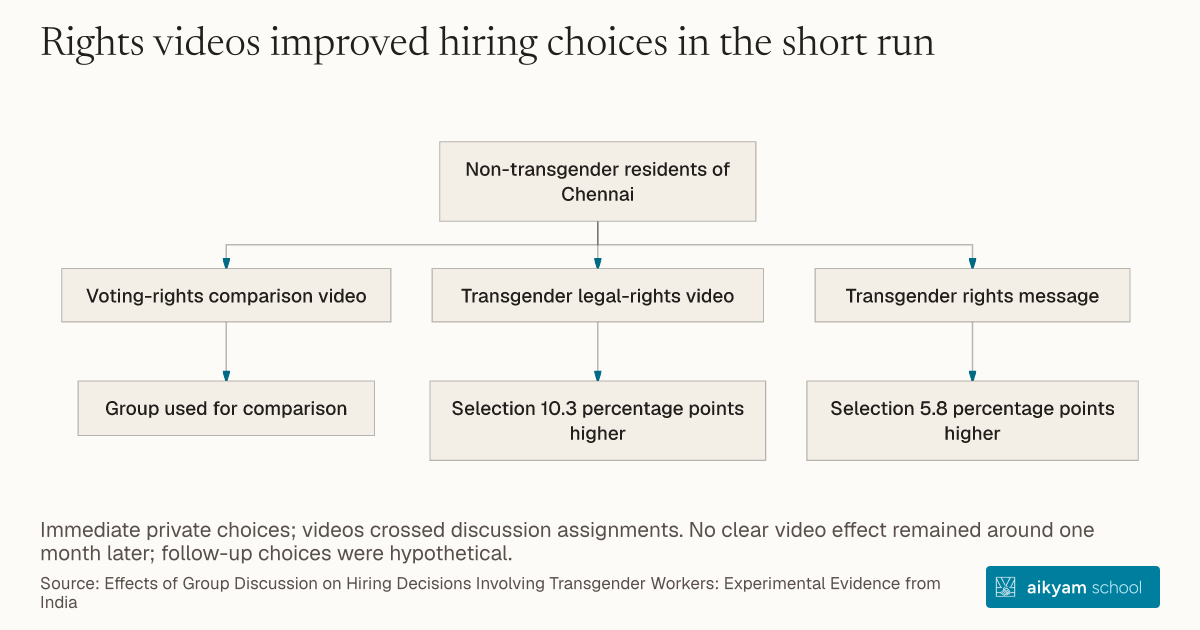
Non-transgender residents of Chennai
- Voting-rights comparison video
- Group used for comparison
- Transgender legal-rights video
- Selection 10.3 percentage points higher
- Transgender rights message
- Selection 5.8 percentage points higher
Immediate private choices; videos crossed discussion assignments. No clear video effect remained around one month later; follow-up choices were hypothetical.
See source →Research question
Top-down information campaigns broadcasting legal rights can generate immediate compliance or behavior shifts, but often lack long-term retention. Policy makers need interventions that sustain bias reduction beyond initial exposure.
Participants
3,397 non-transgender individuals in Chennai, India, with subset groups assigned to video treatment arms (1,135 legal rights video, 1,135 rights messaging video, 1,135 comparison video).
Study Design
Randomized experiment comparing 2-minute video screenings (Supreme Court legal rights vs generic rights messaging vs control) against group discussion treatments, measuring private hiring decisions immediately post-treatment and approximately 35 days later (2–9 weeks).
Results
Viewing legal rights videos initially increased transgender worker selection by 10.3 percentage points (a 23% increase), and generic rights messaging increased selection by 5.8 percentage points (a 13% increase). However, approximately one month after the intervention, behavioral impacts from video screenings decayed completely to zero, whereas peer group discussion impacts persisted significantly at 4 percentage points.
Takeaway
Replace passive legal rights video broadcasts with interactive peer-group dialogue modules in compliance training programs to ensure behavioral persistence beyond one month.
Source and citation
See source →Read alongside the research
Plain-English glossary
Original explanations, informed by the references below. Examples are illustrations, not data from the studies above. The research text stays unchanged.
- Percentage points
The difference between two percentages.
ExampleA rise from 40% to 50% is 10 percentage points. Relative to the starting value, that is a 25% increase.
Office for National Statistics · Percentages ↗Read more about percentage points →