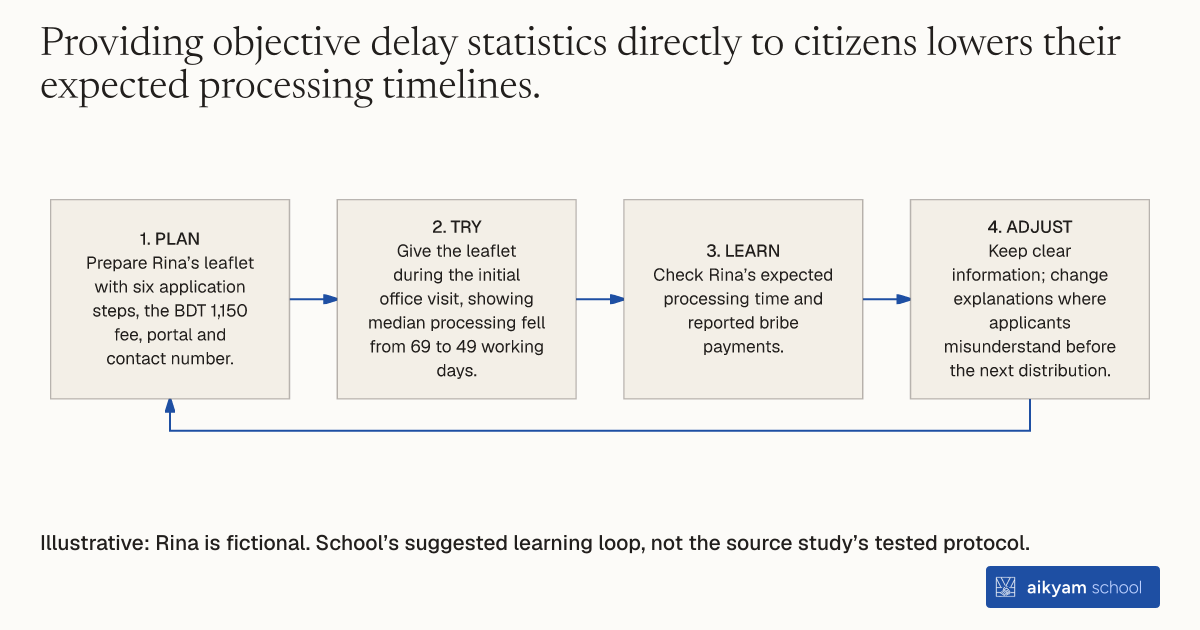
Try, learn and adjust
Check applicants understand official processing information
- Plan: Prepare Rina’s leaflet with six application steps, the BDT 1,150 fee, portal and contact number.
- Try: Give the leaflet during the initial office visit, showing median processing fell from 69 to 49 working days.
- Learn: Check Rina’s expected processing time and reported bribe payments.
- Adjust: Keep clear information; change explanations where applicants misunderstand before the next distribution.
Illustrative: Rina is fictional. School’s suggested learning loop, not the source study’s tested protocol.
See source →Observe expectations and payments; the study did not find a statistically significant bribe reduction. School suggests this learning loop; it was not tested by the source.
How
When to use
Public service applicants often lack accurate information about recent improvements in application processing speeds. This ignorance allows corrupt intermediaries to demand extra payments for routine processing. This method informs citizens directly about actual average processing times and official procedure steps.
Distribute printed informational leaflets to service applicants in public office waiting areas describing recent processing speed improvements and official application steps.
- Design printed leaflets displaying the recent reduction in median application processing days alongside a bar chart comparison.
- Outline the six required application steps, the official BDT 1,150 fee, and the government web portal address.
- Station staff outside subdistrict land offices to identify citizens applying for land record changes.
- Hand printed leaflets directly to applicants during initial office visits on designated distribution days.
- Print a contact telephone number on each sheet for applicant inquiries regarding service delivery timelines.
Why it works
This reduces asymmetric information between applicants and public bureaucrats.
Example
In Bangladesh, staff distributed informational leaflets to 1,559 land record applicants outside subdistrict land offices, informing them that median processing times had dropped from 69 to 49 working days.
About the study
Participants
3,213 land record change applicants surveyed outside 112 subdistrict land offices in Bangladesh (1,559 received leaflets, 1,654 control).
Study Design
Randomized field trial conducted on randomly selected survey days across land offices, measuring applicant processing time expectations and bribe payments.
Results
The leaflets reduced applicants' expected processing time by 5%, but did not cause a statistically significant reduction in bribe payments (BDT 212 increase).