In Simple Words
Providing structured entry-level work and baseline earnings during crucial adolescent development years acts like installing a safety net under a tightrope walker, preventing catastrophic falls into severe criminal justice involvement or fatal physical violence.
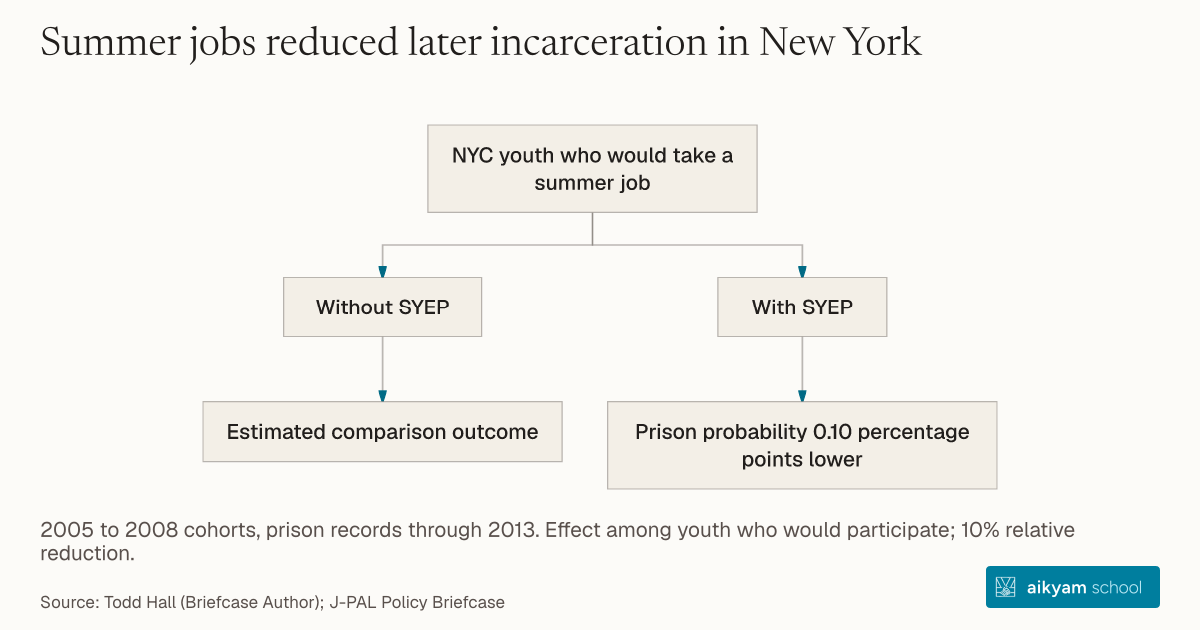
NYC youth who would take a summer job
- Without SYEP
- Estimated comparison outcome
- With SYEP
- Prison probability 0.10 percentage points lower
SYEP participation reduced the probability of state-prison incarceration by 0.10 percentage points through 2013; these are participant effects and estimated counterfactual comparisons. 2005 to 2008 cohorts, prison records through 2013. Effect among youth who would participate; 10% relative reduction.
See source →Research question
Economically disadvantaged youth face disproportionately high risks of incarceration and premature death due to systemic exposure to violent environments and limited legitimate income opportunities. Existing social interventions frequently demand excessive financial expenditure without demonstrating measurable reductions in fatal outcomes.
Participants
Over 30,000 youth per year (ages 14–21) in New York City evaluated across the 2005–2008 program cohorts (from 294,100 qualifying applications; average family income levels were half the national average, ~50% Black).
Study Design
Randomized Controlled Trial (RCT) utilizing initial and subsequent lottery allocations of applicants, matching program records to state corrections incarceration records, IRS tax data, and municipal health department cause-of-death registries.
Results
Participation in the New York City Summer Youth Employment Program (SYEP) reduced the probability of serving prison time by 0.10 percentage points (a 10% reduction from a 0.99% baseline incarceration rate, resulting in 112 fewer youth imprisoned). SYEP participation reduced overall mortality by 0.073 percentage points (an 18% reduction from a 0.41% baseline mortality rate, saving 83 lives), with reductions concentrated among young men.
Takeaway
Implement large-scale lottery-allocated summer youth jobs programs to reduce long-term mortality and incarceration among economically disadvantaged teenagers.
Source and citation
See source →Read alongside the research
Plain-English glossary
Original explanations, informed by the references below. Examples are illustrations, not data from the studies above. The research text stays unchanged.
- Percentage points
The difference between two percentages.
ExampleA rise from 40% to 50% is 10 percentage points. Relative to the starting value, that is a 25% increase.
Office for National Statistics · Percentages ↗Read more about percentage points →- Randomized controlled trial
A study that uses chance, like drawing lots, to decide who receives each option being compared. Researchers compare the groups’ outcomes to estimate the effect of those options.
ExampleA lottery assigns volunteers to a training programme or a comparison group. Researchers then compare their outcomes.
GET-IT glossary · Randomized study ↗Read more about randomized controlled trial →