In Simple Words
Imagine a worker whose total labor costs an employer $100 per day, but taxes and mandatory social security fees reduce the worker's take-home pay to $40 per day. If an unexpected cash windfall causes the worker to cut back hours, the worker only loses $40 in personal spending money for every $100 in total workplace production lost, meaning public taxes absorb most of the financial impact rather than the worker.
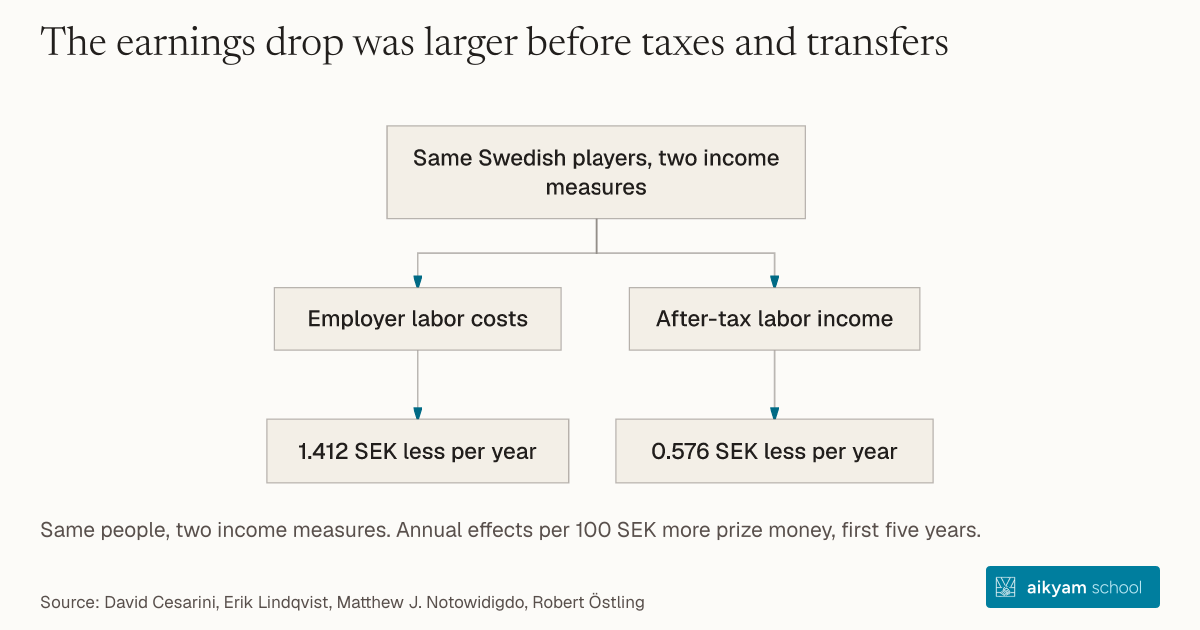
Same Swedish players, two income measures
- Employer labor costs
- 1.412 SEK less per year
- After-tax labor income
- 0.576 SEK less per year
Same players, two income measures. Average annual effects per 100 SEK won over five years; both reductions were statistically significant.
See source →Research question
Progressive labor taxation and payroll social security contributions create a fiscal wedge between the total output value a worker generates for an employer and the net disposable income the worker receives. Evaluating how wealth shocks affect gross versus net earnings determines how tax systems absorb the macroeconomic costs of reduced labor supply.
Participants
N = 244,826 observations across Swedish lottery winners aged 21 to 64.
Study Design
Five-year panel econometric estimation comparing gross labor costs (pre-tax earnings plus employer-paid social security contributions) against net take-home pay across lottery win sizes.
Results
A 100 SEK wealth windfall reduces total employer labor costs (production value) by 1.412 SEK per year (p < 0.001), but reduces net after-tax labor income by only 0.576 SEK per year (p < 0.001); taxes and social security contributions absorb 59.2% of the overall drop in economic output generated by the worker.
Takeaway
Model the fiscal footprint of unearned wealth transfers by accounting for employer payroll tax cushions that cause gross economic production losses to exceed individual disposable income losses by over two to one.