In Simple Words
Imagine a traveler carrying a gold seal stamped by an independent notary on their driver's license, but traffic police ignore the notary seal entirely because they only accept licenses issued directly by the local state motor vehicle department. Employers similarly disregard official third-party degree validations if the candidate lacks host-country work experience.
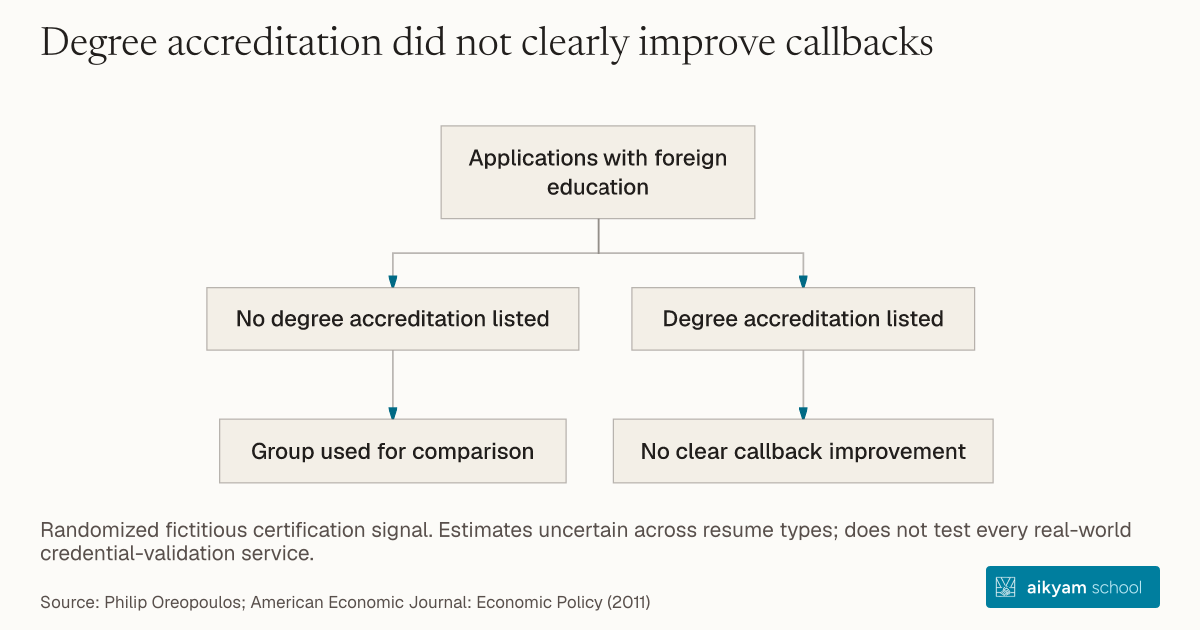
Applications with foreign education
- No degree accreditation listed
- Group used for comparison
- Degree accreditation listed
- No clear callback improvement
Randomized fictitious certification signal. Estimates uncertain across resume types; does not test every real-world credential-validation service.
See source →Research question
Public policy initiatives frequently propose formal third-party skill certification or degree accreditation boards to validate foreign qualifications and eliminate employer uncertainty regarding foreign education, assuming certification will equalize interview opportunities.
Participants
Sub-sample of mock resumes with foreign education (Types 2, 3, and 4) submitted to job postings in Toronto and Montreal.
Study Design
Randomized audit field experiment assigning fictitious "Canada International Skills Certification Board" accreditation badges to resumes with foreign credentials to test the effect on employer callback rates.
Results
Attaching formal third-party accreditation to foreign educational credentials produced virtually zero effect on callback rates (point estimates ranging from -0.014 to +0.007, statistically insignificant), failing to reduce the callback gap between foreign-educated and native-educated applicants.
Takeaway
Policy makers should reallocate public funding from formal foreign credential evaluation agencies toward direct local workplace bridge programs that provide newcomers with verifiable host-country experience.