Try, learn and adjust
Check reference letters describe work without ratings
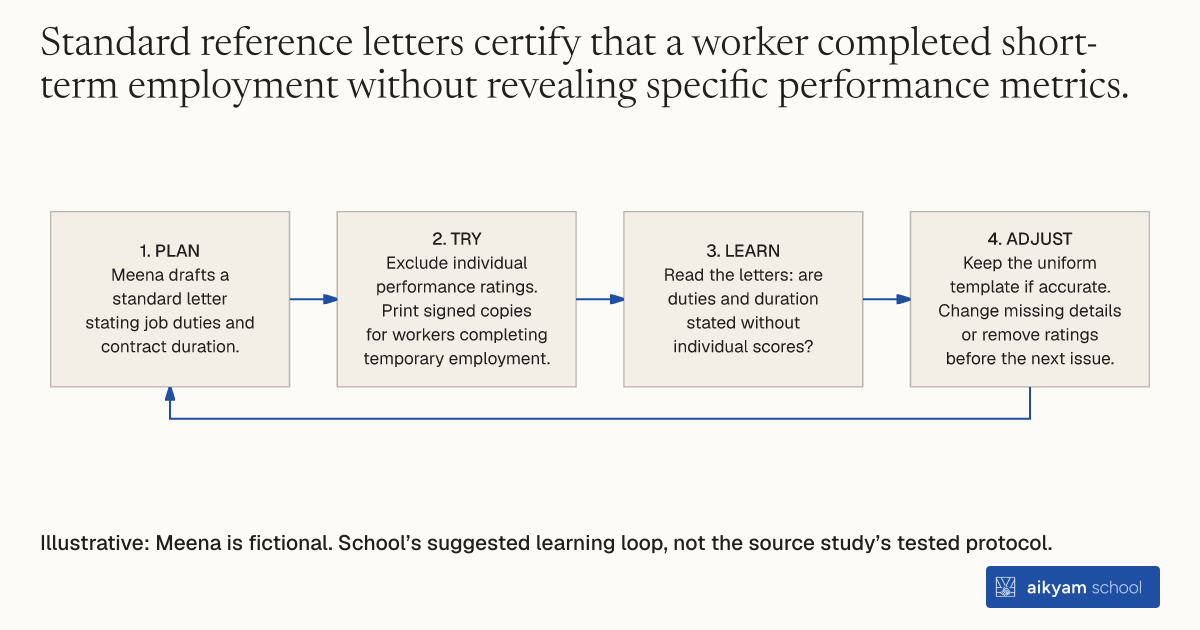
- Plan: Meena drafts a standard letter stating job duties and contract duration.
- Try: Exclude individual performance ratings. Print signed copies for workers completing temporary employment.
- Learn: Read the letters: are duties and duration stated without individual scores?
- Adjust: Keep the uniform template if accurate. Change missing details or remove ratings before the next issue.
Illustrative: Meena is fictional. School’s suggested learning loop, not the source study’s tested protocol.
See source →Observe job descriptions, contract duration and absence of individual ratings; do not assume later job gains. School suggests this learning loop; it is not the source’s tested procedure.
How
When to use
Employers in developing labor markets often issue reference letters to document past work experience for job seekers. Providing standardized reference letters describes overall job duties without evaluating individual worker performance. This method serves employers completing temporary employment contracts with young workers.
Issue standardized reference letters to participants completing temporary employment contracts.
- Draft a uniform reference letter template describing general job duties and contract duration.
- Exclude individual performance marks or personal ratings from the text of the letter.
- Print signed copies of the reference letter for each participant finishing the work assignment.
- Hand the reference letters to participants upon completion of their temporary employment.
Why it works
Workers leveraging personal social contacts rely less on paper documentation during future job applications.
Example
An international research team in Lilongwe, Malawi issued generic reference letters to male youth completing 5 days of short-term interviewer work. The letters detailed the general nature of survey work without disclosing individual performance test scores.
About the study
Participants
227 urban male youth job seekers in Lilongwe, Malawi, followed up 9 months after intervention completion.
Study Design
Randomized Controlled Trial using instrumental variables to estimate reference letter usage rates during subsequent job applications.
Results
Receiving work experience decreased reference letter submission probability by 7.9 percentage points (p > 0.10) and reduced average reference letter usage frequency by 0.381 times.